Table of Contents
Your Sub No-Showed Again. Now What?
Why subcontractor coordination chaos is costing you more than you think
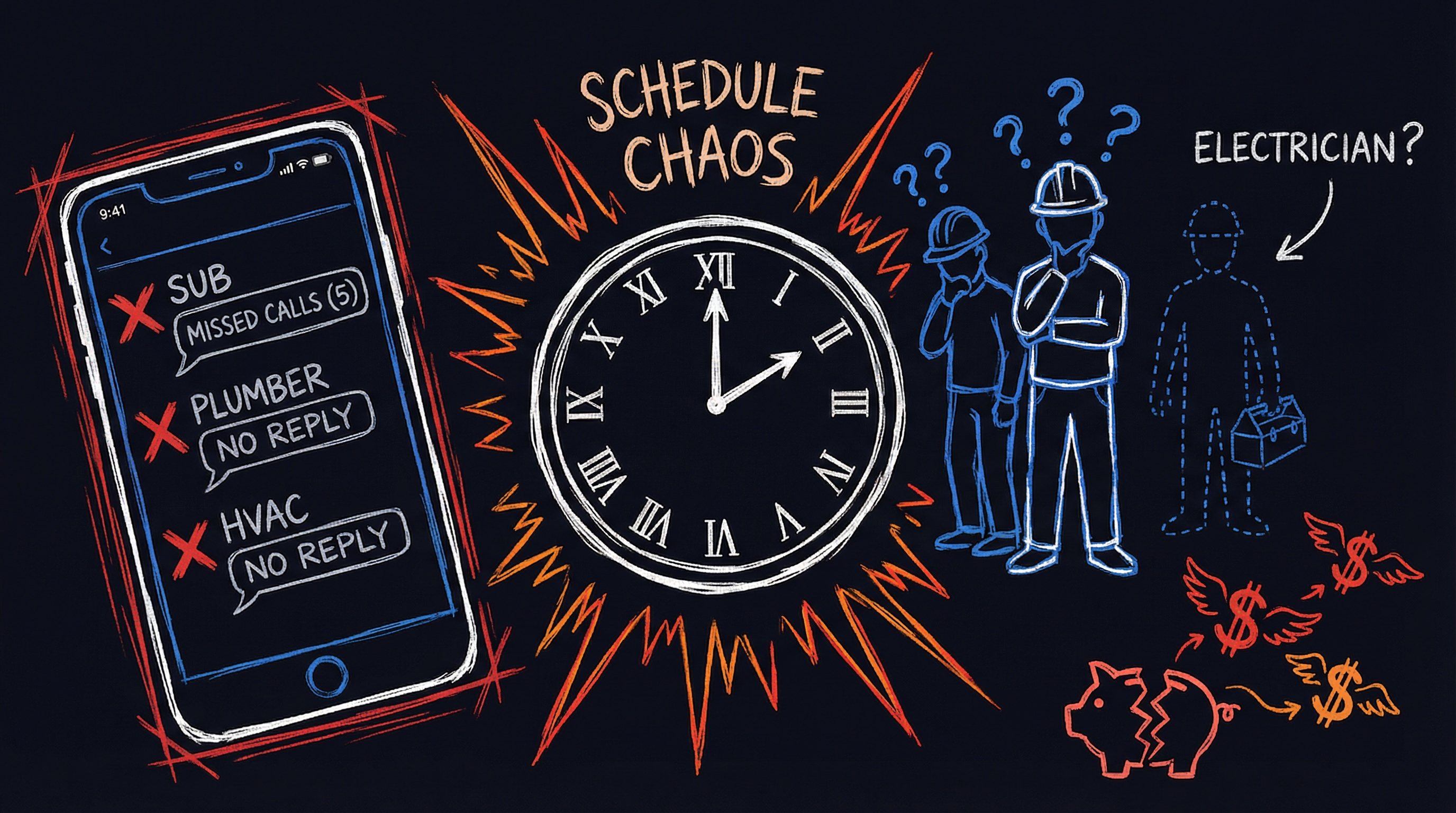
The electrician was supposed to rough-in at 8 AM so your drywall crew could start at noon. It’s now 2 PM. No electrician. No call. Your drywall guys have been standing around for two hours—on your dime.
You’ve called three times. Texted twice. Nothing.
Now your drywall crew is pissed. Your schedule just cascaded into next week. And you’re about to have an uncomfortable conversation with the homeowner about why their project is delayed. Again.
Why This Keeps Happening
You’re not bad at scheduling. You’re trying to coordinate multiple independent businesses using text messages and verbal agreements.
Monday: You confirm with the electrician. “Yeah, I’ll be there Tuesday 8 AM.”
Tuesday 7:45 AM: You assume he’s on his way.
Tuesday 9:30 AM: First call goes to voicemail.
Tuesday 11:00 AM: “Hey man, sorry, got pulled to an emergency. Can we do Thursday?”
Your schedule: Destroyed. Three crews rescheduled. Customer trust eroding.
Here’s the thing: The electrician isn’t a bad person. He’s running his own small business, juggling his own chaos. Your job wasn’t in his system—it was a text he forgot about.
What This Actually Costs
A typical GC running 3-4 concurrent projects:
- 2-3 no-shows per month (conservative for busy seasons)
- Average 4 hours of crew idle time each incident ($300-$500 in labor)
- 1-2 days schedule cascade per incident (ripple effects)
- Customer frustration (harder to quantify, but real)
Conservative annual cost: $15,000-$25,000 in idle labor, rescheduling overhead, and lost efficiency.
That’s not counting the jobs you didn’t bid because you couldn’t trust your schedule. Or the referrals you lost because customers mentioned delays in their reviews.
The Real Problem
Most subcontractor coordination looks like this:
- Verbal agreement at initial meeting
- Text confirmation a few days before
- Hope they show up
- Scramble when they don’t
There’s no system. No accountability. No visibility. You find out about problems when your crew is already standing around with nothing to do.
Meanwhile, your subs are doing the same thing with their other GCs. Whoever yells loudest or pays fastest gets priority. Your carefully planned schedule is competing with everyone else’s emergencies.
Two Types of Contractors
Type 1: Accepts that “subs are unreliable” and builds massive buffer time into every schedule. Over-promises timelines to compete, then constantly apologizes for delays.
Type 2: Has systems that create accountability. Subs who work with them know exactly when they’re expected, get reminded automatically, and understand that no-shows have consequences.
The gap between these two is widening. Customers are getting used to the professional experience Type 2 contractors deliver. Type 1 contractors are competing on price because they can’t compete on reliability.
Next: How Smart Contractors Stopped the Sub Shuffle - The coordination system that cut no-shows by 80%.
P.S. - Ready to stop playing phone tag with subs? Book a 60-minute Strategy Session where we’ll map your current coordination chaos and design a system that creates real accountability. $150, credited toward implementation.
AIL-3 | AI Transparency: This article was drafted with AI assistance and reviewed, edited, and approved by the author. All recommendations are based on 20 years of experience in the roofing and construction industry.