Your Phone Buzzed 200 Times Today. How Many Actually Mattered?
- Rob Pratt
- Automation , Construction , Business
- June 9, 2026
Table of Contents
Your Phone Buzzed 200 Times Today. How Many Actually Mattered?
How bad automation design trains you to ignore the alerts that actually cost you money
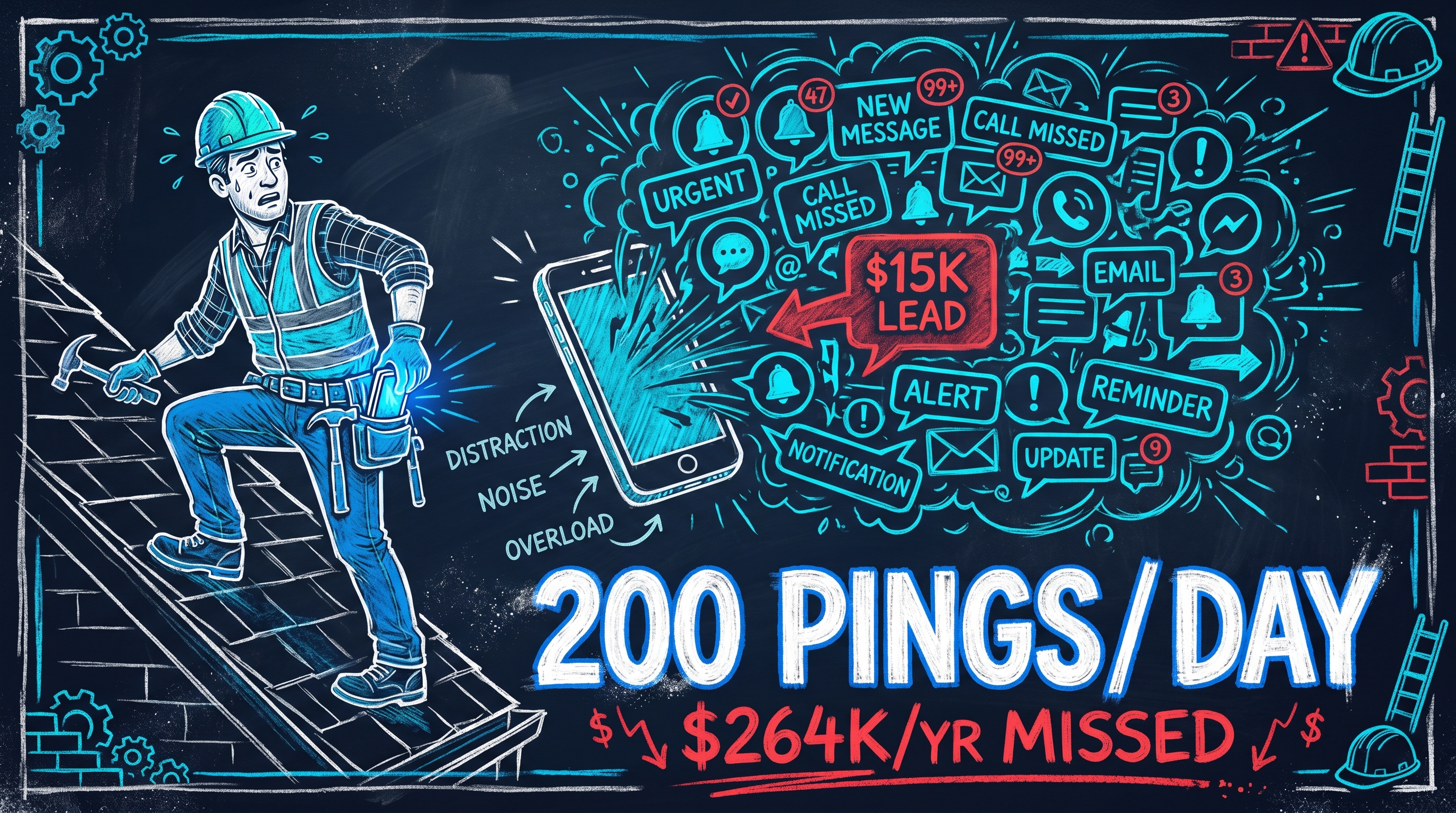
You’re up on a roof doing a walk-through when your phone buzzes. You glance at it from your back pocket — another notification from your CRM. Something about a form submission.
You pocket the phone and keep walking.
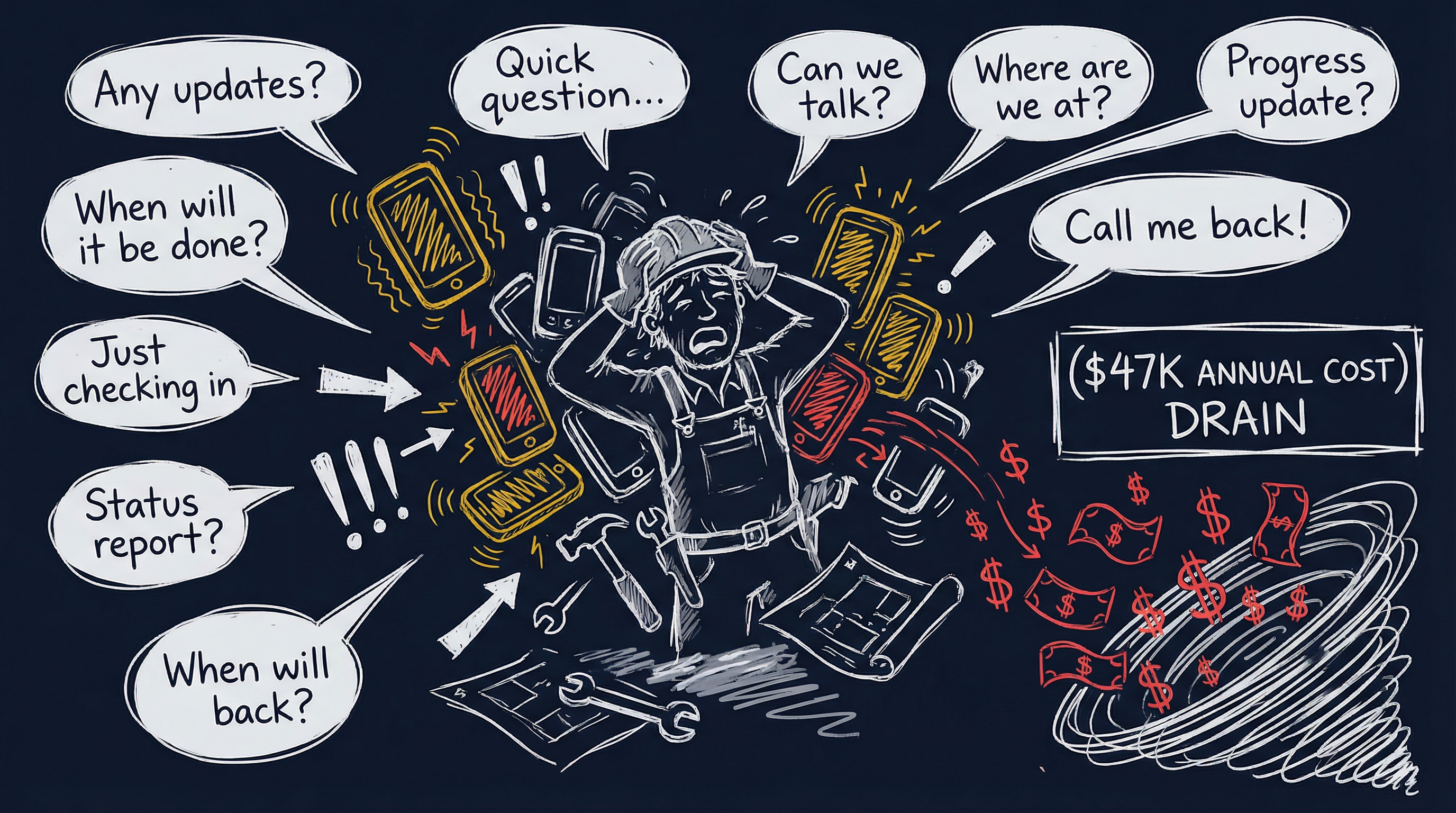
By lunch, you’ve had 23 more pings. Three CRM alerts. Two job status updates. Four texts from your software platform. Seven emails flagged as “urgent.” A handful of app badges you stopped reading a month ago.
At 2:15 PM, you finally sit down and scroll through everything. That’s when you see it: a commercial roofing estimate request submitted at 9:51 AM. A building owner. 14,000 square feet. Realistic budget. Ready to move.
He submitted the same request to three contractors. The other two called him back before noon.
You lost the job before you even knew it existed — because the notification that mattered looked exactly like the 46 that didn’t.
Why This Keeps Happening
Most contractors assume their problem is that they need more automation. More alerts. More coverage. More integrations.
The real problem is the opposite.
When you set up your first automation system and it starts firing — CRM pings, invoice reminders, job updates, follow-up sequences, team messages, scheduling alerts — it feels like the system is working. It’s doing things. It’s busy.
But there’s a threshold. And most contractors blow past it within the first few weeks.
Research on workplace notifications puts that threshold at around 50 alerts per day. Above that, the human brain starts treating all incoming notifications as background noise. It’s not a discipline problem. It’s neurological. Your brain literally cannot assign equal urgency to everything — so it starts discounting everything.
You’ve been trained by your own system to ignore your own system.
What This Actually Costs
A mid-size roofing contractor sees roughly 12-18 qualified leads per month. At an average job value of $11,000, each one represents serious money. If notification numbness causes you to miss even 2 of those per month — because the alert got buried under 40 others — you’re leaving $22,000 on the table every month.
That’s $264,000 per year in missed revenue from a problem most contractors don’t even recognize they have.
And that’s just the direct cost. It doesn’t account for the customer whose warranty claim sat unread for three days. Or the subcontractor change you didn’t see until the crew showed up expecting materials that weren’t there.
When everything is an emergency, nothing is.
Two Types of Contractors
The “More Is More” contractor keeps his phone on silent because he can’t function otherwise. He does a batch review twice a day — sometimes — but on busy job site days it slips to once, or zero. His automation is faithfully alerting him about everything: a lead came in, the lead opened an email, the lead clicked a link, the follow-up sent step one, the follow-up sent step two, an invoice was created. All of it, all day. A waterfall of pings. He has automation, but he doesn’t have clarity.
The “Signal Over Noise” contractor gets 8-10 pings a day. She reads every one of them, because every one of them means something. A new qualified lead — that’s a ping. A prospect asking to schedule an estimate — that’s a ping. An invoice hitting 21 days unpaid — that’s a ping. Everything else runs silently. She set up her automation to respect her attention. So when it asks for it, she gives it.
Same automation infrastructure. A fraction of the interruptions. Zero missed opportunities.
Next: How Smart Contractors Built Alerts That Actually Matter - The three-tier notification system that drops 200 daily pings down to 8 and stops missing $15K leads.
P.S. - If you’re running automation that’s generating more noise than signal, book a 60-minute Strategy Session. We’ll map exactly which alerts are driving decisions and which ones are just burning your attention. $150, credited toward implementation.
AIL-3 | AI Transparency: This article was drafted with AI assistance and reviewed, edited, and approved by the author. All recommendations are based on 20 years of experience in the roofing and construction industry.