Table of Contents
You Started This Business for Freedom. So Why Are You Working Every Sunday?
The paperwork trap that keeps successful contractors chained to the kitchen table
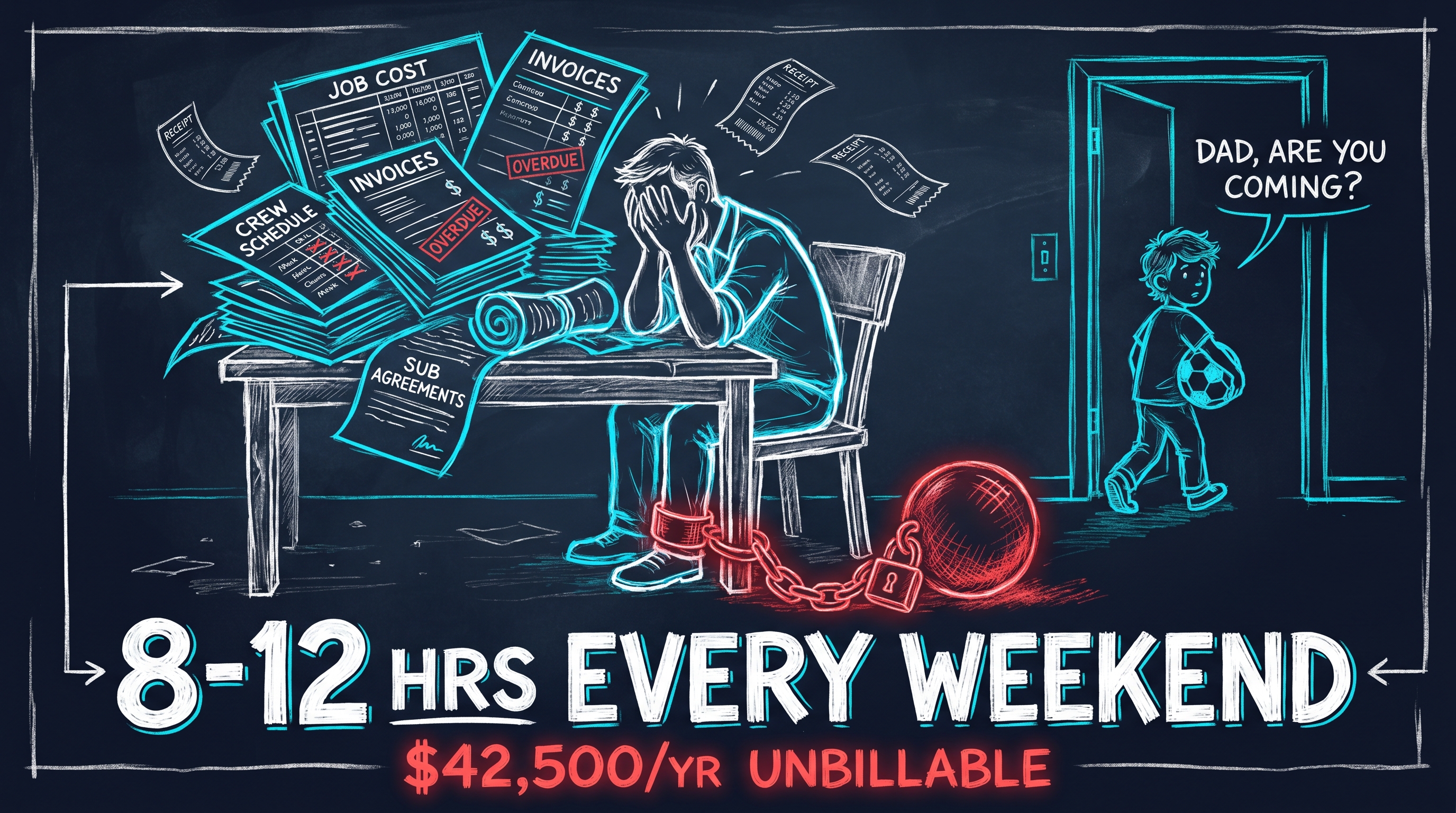
Sunday, 2:43 PM. Your kid is at the back door with a soccer ball under his arm. “Dad, are you coming to the park?”
You look up from the pile of receipts spread across the kitchen table. You’ve been at this since noon. Job cost spreadsheet. Invoices to write up. Monday’s crew schedules. Sub agreements to track down.
“Give me an hour,” you tell him.
He drops the ball and walks back inside without a word.
You started this business so you’d never answer to anyone else. So you could build something. So you’d have time for moments exactly like the one that just walked away from you.
What This Is Actually Costing You
Most contractors track their billable hours. Almost none of them track what their Sundays are costing them.
Here’s a conservative breakdown:
The time math:
- Average Sunday paperwork session: 4-6 hours
- Weeknight catch-up (Tuesday, Thursday): 2-3 hours total
- Total administrative time outside business hours: 8-12 hours per week
The financial math:
- If your billable rate is $85/hour, those 10 hours = $850 in value given away for free
- Over 50 working weekends per year: $42,500 in your own unbillable time
- Over 5 years: $212,500
That’s not counting what it costs your marriage, your relationship with your kids, or the fact that you’re making decisions at 9 PM when you’re exhausted and resentful — and those decisions run your company.
Why This Keeps Happening
You’re not disorganized. You’re not lazy. You’re probably one of the hardest-working people in your zip code.
The problem is structural.
Your business generates information constantly — customer details, job site notes, material costs, change orders, crew hours, invoices, follow-ups. Right now, the system for moving all that information is: you. Manually. At the end of the week when you finally have a quiet moment.
Every piece of information goes through your hands twice — once when it happens, once when you record it. Every job update gets written in a field notebook, then re-entered somewhere else. Every receipt goes in a pocket, then in a pile, then into a spreadsheet.
You’re not behind because you work too slowly. You’re behind because the system requires you to do everything twice.
Two Types of Contractors in Your Market
Contractor A does this every Sunday. Kitchen table. Receipts. Spreadsheets. Phone calls he forgot to return. Crew schedules texted individually. Job notes typed up from handwritten scrawl.
His wife has stopped asking if he’s coming to dinner. His kids have stopped asking him to the park.
He tells himself this is just what it takes to run a business. He’s right — with his current systems.
He’s also building a ceiling above himself. Can’t take on more work because he’s already maxed out. Can’t hire help because training takes time he doesn’t have. Can’t raise prices because he’s not sure which jobs are actually profitable.
Result: Stuck at the same revenue level he was three years ago, just more tired.
Contractor B went to his kid’s soccer game on Sunday. He grilled something. He watched a movie with his wife.
His business ran itself over the weekend. Monday morning he checks a dashboard for 20 minutes and knows exactly where everything stands.
The difference isn’t talent. It’s what he chose to automate.
Next: How Smart Contractors Got Their Weekends Back - What actually gets automated and what it takes to get there.
P.S. - If you’re tired of your weekends belonging to your paperwork, let’s map exactly what’s eating your time and what it would take to get it back. Book a 60-minute Strategy Session →
AIL-3 | AI Transparency: This article was drafted with AI assistance and reviewed, edited, and approved by the author. All recommendations are based on 20 years of experience in the roofing and construction industry.