Table of Contents
You Just Sent Your Guy to Pick Up Materials You Already Have
Why “we’ll just grab it real quick” is costing you thousands
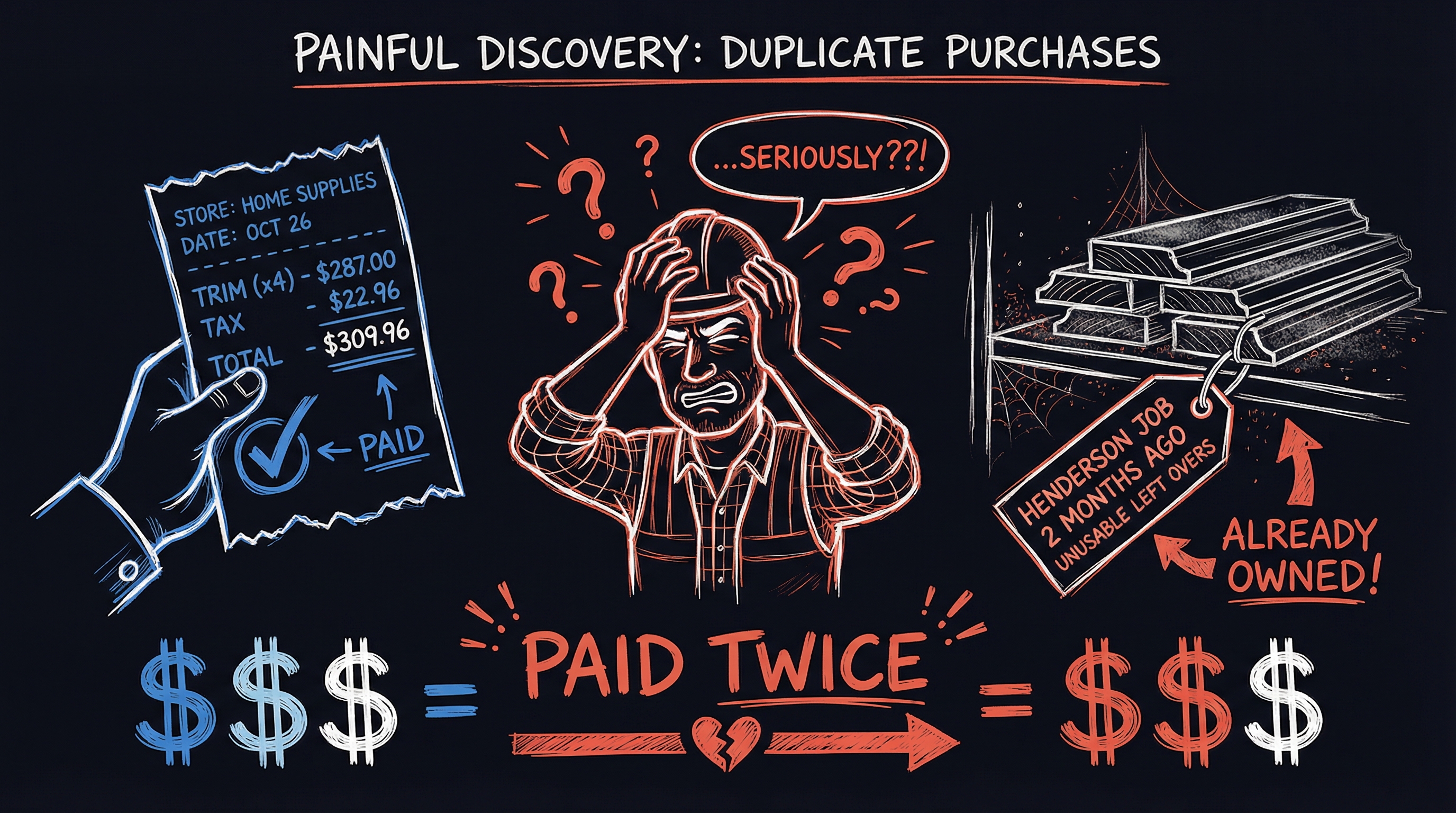
It’s Wednesday morning, 9:47 AM. Your crew calls from the job site—they’re three pieces of trim short for the window install. You send Jake to the supply house. He returns 90 minutes later with $287 worth of materials.
Thursday afternoon, you’re looking for something in the shop. Behind the miter saw, you find the exact trim Jake bought yesterday. Still bundled. From the Henderson job two months ago.
You just paid for the same materials twice. Plus three hours of Jake’s labor. Plus lost productivity. Total: $371 for materials you already owned.
This isn’t a one-time mistake. It’s Tuesday for most contractors.
The Real Cost of Material Chaos
Most contractors don’t track materials beyond “roughly where we left it” and “probably have some in the shop.” The consequences compound fast:
Over-ordering because you can’t find what you have: You know you’ve got materials somewhere, but finding them takes longer than just buying new. Result: $3,000-5,000 in duplicate materials per quarter.
Emergency runs mid-job: Crew standing around while someone makes a supply house run. At $150-250/hour for a full crew, a two-hour delay costs $300-500. Do this 2-3 times weekly and you’re burning $3,000-6,000 monthly.
Shrinkage you can’t account for: Materials walk away—to other jobs, to personal projects, to who-knows-where. Without tracking, you can’t tell used from lost from stolen. Industry average: 3-5% of material costs simply vanish.
Change orders you can’t prove: Customer questions your materials invoice because you can’t show exactly what went to their job. You eat the cost or damage the relationship.
Two Types of Contractors
Type 1: Digs through the shop trying to remember if they used all that siding on the Morrison job. Sends crews to supply houses mid-job. Loses 3-5% to shrinkage they can’t even measure.
Type 2: Knows exactly what they have, where it is, and what it cost. Doesn’t send crews mid-job because they verified inventory before leaving. Catches shrinkage early because the system flags when quantities don’t match.
Their material costs are 8-12% lower. Not because they work harder—because they track smarter.
Next: How Smart Contractors Stopped Buying Materials Twice - The tracking system that cut material costs 8-12%.
P.S. - Ready to stop paying for materials you already own? Book a 60-minute Strategy Session where we’ll map your current material flow and identify where you’re losing money. $150, credited toward implementation.
AIL-3 | AI Transparency: This article was drafted with AI assistance and reviewed, edited, and approved by the author. All recommendations are based on 20 years of experience in the roofing and construction industry.