Table of Contents
Why “She’s Salaried Anyway” Is Strangling Your Growth
How manual busywork is turning your office into a bottleneck instead of a growth engine
The 3 PM Reality Check
It’s mid-afternoon and your best salesperson calls the office: “Can you pull together that material list for the Henderson estimate? And did we ever follow up with the Miller lead from last week?”
Your office manager looks up from a pile of invoices she’s been manually entering into three different systems and sighs. “I’ll get to it when I can – I’m still processing Monday’s paperwork.”
Meanwhile, the Henderson estimate sits incomplete and the Miller lead goes cold. But hey, she’s salaried anyway, so her time doesn’t cost extra, right?
The Hidden Chokehold on Your Business
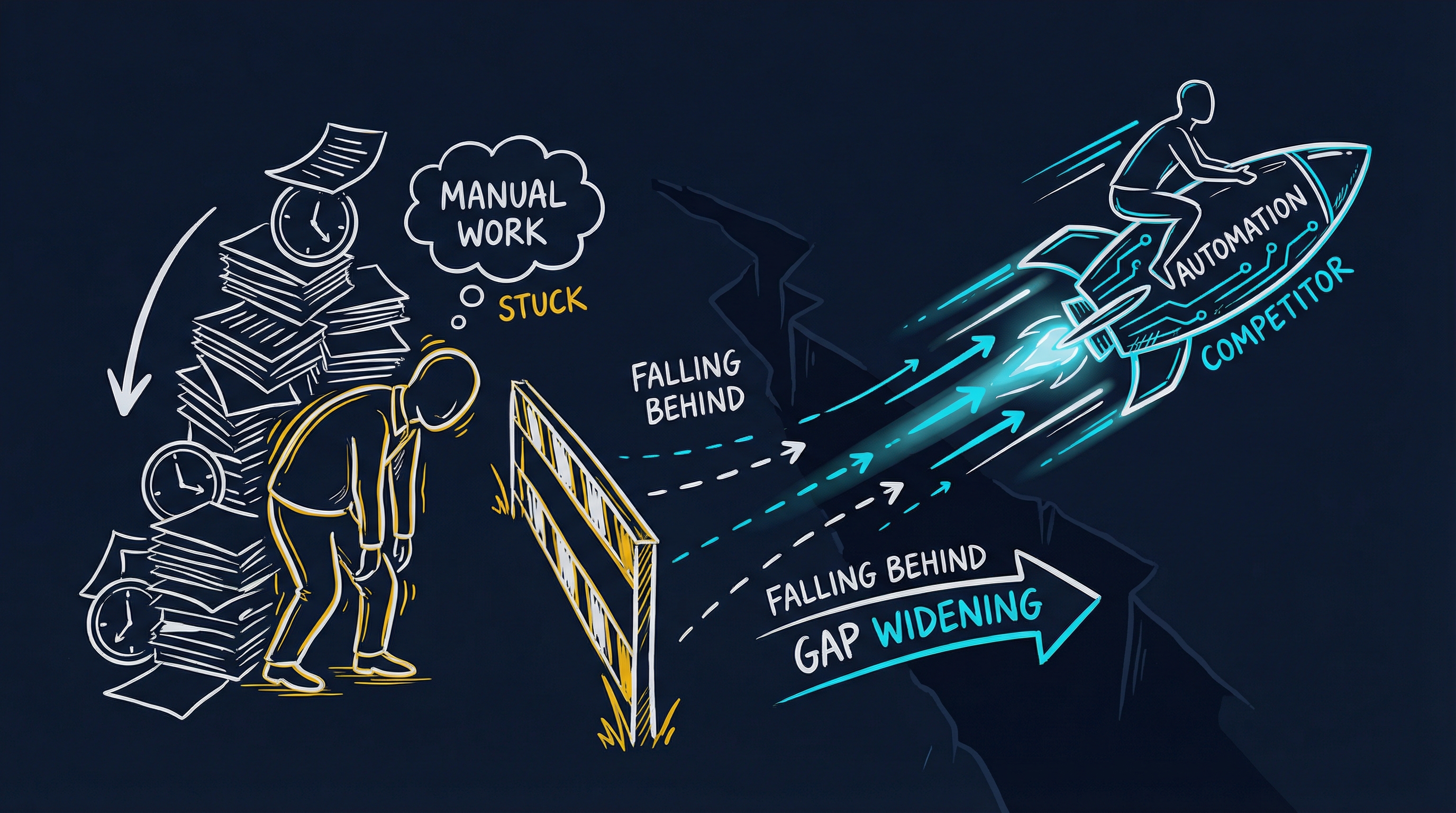
Here’s what most contractors don’t realize: When your office is buried in manual busywork, your entire sales operation gets bottlenecked.
What Your Office Should Be Doing (Revenue-Generating Activities):
- Supporting sales team with quick estimate materials
- Following up on warm leads within 24 hours
- Scheduling appointments and managing calendars
- Coordinating with suppliers for material quotes
- Handling customer communications professionally
- Managing project logistics and timelines
What They’re Actually Doing (Manual Busywork):
- Re-entering the same customer data into 4 different systems
- Manually creating invoices from completed work orders
- Filing and organizing paper documents
- Chasing down information that should be automated
- Playing phone tag to update project statuses
- Fixing errors from manual data entry
The Result: Your sales team can’t move at full speed because the office can’t keep up with support tasks.
The Real Cost of “Free” Office Time
Let’s break down what this bottleneck actually costs you:
Lost Revenue Opportunities:
- Slow estimate turnaround: Competitors beat you with faster quotes
- Missed follow-ups: Warm leads go cold while office catches up on busywork
- Limited sales capacity: Can’t take on more prospects because office is maxed out
- Poor customer experience: Delayed responses make you look unprofessional
Conservative Math on a $500K Annual Revenue Business:
- Office buried in manual work → Sales team 30% less efficient
- 30% efficiency loss → $150,000 in missed growth opportunities
- That “free” salaried time just cost you six figures
Two Different Approaches to Office Operations
Company A: “Salaried Time is Free” Mindset
- Office manager spends 6 hours daily on data entry and manual tasks
- Sales team waits for office support, moves slower on opportunities
- Customer inquiries take 24-48 hours to get proper responses
- Growth limited by administrative capacity
- Result: Competing on price because they can’t compete on service
Company B: “Office as Growth Engine” Mindset
- Automated systems handle routine data entry and filing
- Office focuses on supporting sales and customer experience
- Lead responses happen within 2 hours, estimates within 24 hours
- Sales team operates at full capacity with strong office support
- Result: Premium pricing because of superior service delivery
The difference isn’t staff quality – it’s system efficiency.
What Smart Contractors Are Automating Right Now
Instead of keeping office staff buried in manual work, successful contractors automate:
Data Entry Elimination:
✓ Customer information enters once, populates everywhere needed
✓ Work orders auto-generate from approved estimates
✓ Invoice creation happens automatically when jobs complete
✓ Project photos organize themselves by job and date
Communication Streamlining:
✓ Lead inquiries trigger immediate professional responses ✓ Customer updates send automatically at project milestones ✓ Follow-up sequences keep prospects engaged without manual effort ✓ Appointment scheduling happens without phone tag
Information Flow Optimization:
✓ Sales team gets instant access to customer history and project details ✓ Material lists and supplier quotes integrate seamlessly ✓ Project status updates in real-time across all systems ✓ Document filing and organization happens automatically
Time Savings: 15-20 hours per week of manual work eliminated
From My Own Experience: The Transformation
When I was running construction operations, our office was the bottleneck. My sales guys were constantly frustrated waiting for estimate support, and we were losing deals to faster competitors.
Before Automation:
- Office spent 70% of time on manual tasks
- Sales team effectiveness limited by office capacity
- Response time to leads: 24-48 hours average
- Could handle about 20 active prospects at once
After Implementation:
- Office spends 20% of time on manual tasks
- Sales team operates at full capacity with strong support
- Response time to leads: 2-4 hours average
- Can handle 40+ active prospects simultaneously
- Revenue increased 35% in first year with same staff size
The investment was our Growth Package implementation. Payback period: 4 months through increased efficiency and revenue growth alone.
The Compound Effect of Efficiency
Here’s what happens when you free your office from manual busywork:
- Month 1-3: Immediate time savings, faster response times, less stress
- Month 4-6: Sales team hitting higher activity levels, conversion rates improve
- Month 7-12: Handling significantly more volume without adding staff
- Year 2+: Market reputation for professionalism creates premium pricing opportunities
Your “salaried anyway” office becomes your competitive advantage.
Stop Treating Support Staff Like Data Entry Clerks
The contractors winning in today’s market understand a simple truth: Office efficiency directly impacts sales performance.
When your office can respond quickly, support sales activities, and handle customer communications professionally, your entire business operates at a higher level.
When they’re buried in manual busywork, everyone suffers – including your bottom line.
Your Next Step: Free Assessment
If you’re tired of watching talented office staff waste time on manual tasks instead of supporting business growth, let’s talk.
Ready to turn your office into a growth engine? Book a 60-minute Construction Automation Strategy Session ($150, credited toward implementation) where we’ll:
- Identify your biggest office bottlenecks and their impact on sales performance
- Design specific systems that could free up 15+ hours weekly of manual work
- Calculate the real cost of your current “salaried anyway” approach and ROI potential
- Create a complete transformation roadmap for your office operations
This is a premium consultation where you get actionable strategies to unlock your sales team’s full potential.
CLICK HERE TO SCHEDULE YOUR STRATEGY SESSION
The Bottom Line
Your office staff costs the same whether they’re supporting sales growth or doing manual data entry.
The question is: How much longer can you afford to let administrative bottlenecks limit your sales team’s potential?
Your competitors are making this choice right now. Which side do you want to be on?
Frequently Asked Questions
How do I calculate the opportunity cost of my salaried staff’s time?
Track what your salaried employees spend time on for one week. Calculate hours on administrative tasks × the revenue they could generate if focused on growth activities instead. An office manager spending 25 hours weekly on paperwork who could handle customer service generating $6,000 monthly revenue represents $72,000 annual opportunity cost.
What if my employees like the current manual processes?
Most employees hate repetitive administrative work - they just don’t see alternatives. When you frame automation as “eliminating the boring stuff so you can do meaningful work,” resistance usually disappears. Top performers embrace automation because it lets them focus on work that actually uses their skills and experience.
Can small construction companies really afford automation?
Starter automation packages ($5,000-$15,000) typically pay for themselves in 4-6 months through efficiency gains alone. You can’t afford NOT to automate when competitors are handling 50% more volume with the same overhead. The question isn’t cost - it’s whether you can compete long-term without it.
How much administrative work can actually be automated?
Estimate creation, follow-ups, scheduling, invoicing, payment tracking, progress updates, and document management can be 70-85% automated. Your staff shifts from doing administrative tasks to managing systems and handling exceptions. One person with good automation can do the work of 2-3 people operating manually.
What happens to my employees after automation?
Their roles evolve to higher-value work. The office manager handling paperwork becomes the customer experience specialist building relationships. The estimator drowning in data entry becomes a revenue generator creating more quotes and closing more deals. Automation doesn’t eliminate positions - it amplifies their impact.
P.S. – The contractors who optimize their office operations don’t just grow faster – they build more valuable businesses. Systematic support operations reduce owner dependency and create the foundation for sustainable scaling.
AIL-3 | AI Transparency: This article was drafted with AI assistance and reviewed, edited, and approved by the author. All recommendations are based on 20 years of experience in the roofing and construction industry.