Table of Contents
What’s Eating Up 20+ Hours of Your Week? (And How Smart Contractors Are Getting It Back)
The hidden time-wasters that are keeping your construction business stuck in first gear
The Thursday Afternoon Reality Check
It’s 4 PM and your phone rings. Your best client wants a quick material estimate for an add-on to their current project. Should be simple, right?
Except your office manager is still buried in Tuesday’s paperwork, manually entering the same customer data into three different systems. The estimate that should take 30 minutes will have to wait until tomorrow – if she can find time between processing invoices and chasing down last week’s unpaid bills.
Meanwhile, your client calls your competitor instead.
Sound familiar?
The 20-Hour Time Thief
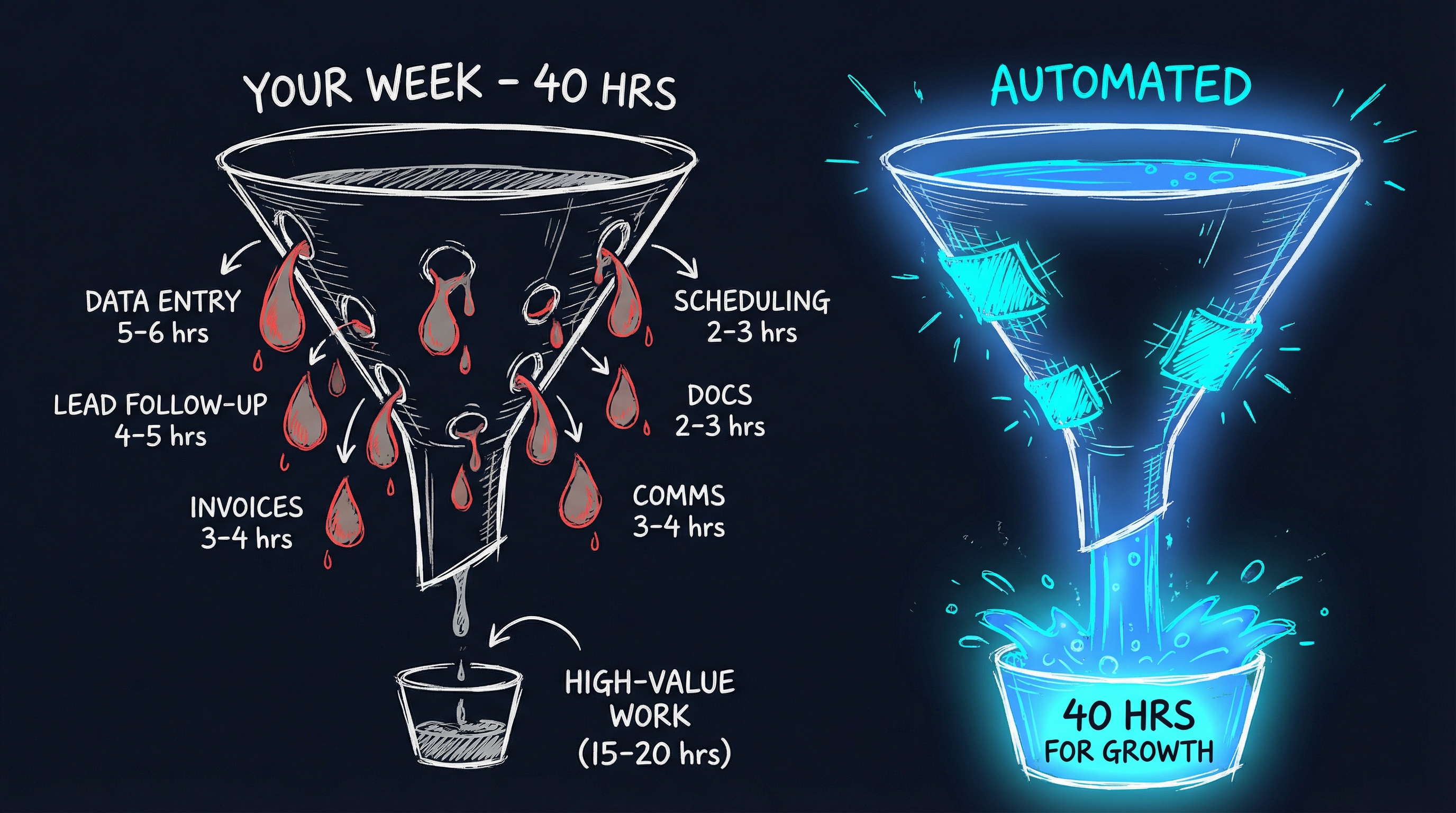
Here’s what most contractors don’t realize: You’re losing 20+ hours every week to tasks that could run themselves.
What’s Stealing Your Time Right Now:
- Invoice creation and payment follow-ups (3-4 hours weekly)
- Appointment scheduling back-and-forth (2-3 hours weekly)
- Manual data entry across multiple systems (5-6 hours weekly)
- Social media posting and customer communications (3-4 hours weekly)
- Document creation and contract management (2-3 hours weekly)
- Lead follow-up and pipeline management (4-5 hours weekly)
Total: 20-25 hours of work that smart contractors have eliminated entirely.
What Actually Matters in Your Business
While you’re stuck doing busywork, your successful competitors are spending those same 20+ hours on:
- Meeting with high-value prospects and closing bigger deals
- Building relationships with suppliers and referral partners
- Strategic planning for growth and expansion
- Quality control and job site supervision
- Team development and skill building
The difference isn’t talent or market conditions – it’s where you spend your time.
The Automation Advantage: Real Examples
Scenario 1: Lead Response Speed
Before: Lead comes in Friday evening, gets first response Monday afternoon (if remembered) After: Lead gets professional response within 2 hours, even on weekends, with appointment scheduling link
Result: 40% higher lead conversion rates
Scenario 2: Invoice and Payment Management
Before: Create invoices manually, email individually, track payments on spreadsheets, chase late payers with phone calls After: Invoices generate automatically when jobs complete, payment reminders send themselves, online payments process instantly
Result: Get paid 18 days faster on average
Scenario 3: Customer Communication
Before: Answer same questions repeatedly, remember to follow up on estimates, manually send project updates After: Common questions answered instantly by chatbot, follow-ups happen automatically, customers get project updates without you lifting a finger
Result: Look more professional while doing less work
The Compound Effect Nobody Talks About
When contractors eliminate these time-wasters, something interesting happens:
Month 1: You get 20+ hours back per week
Month 2: You can handle more leads without adding staff
Month 3: Faster response times start winning you more jobs
Month 4: You’re operating at higher volume with same effort level
Month 6: Competitors start asking how you’re responding so quickly
Month 12: You’re the “premium service” contractor in your market
The contractors who automate early become the ones everyone else is trying to catch.
What Smart Contractors Are Automating Right Now
The most successful construction businesses I work with have eliminated manual work in these key areas:
Customer Communication Systems:
✓ Lead inquiries get instant professional responses ✓ Estimate follow-ups happen automatically until they say yes or no ✓ Project updates send themselves at key milestones ✓ Payment reminders go out before bills are even late
Administrative Workflows:
✓ Customer data enters once, populates everywhere it’s needed ✓ Invoices create themselves when work orders are marked complete ✓ Appointment scheduling happens without phone tag ✓ Documents organize and file themselves automatically
Sales Pipeline Management:
✓ Every lead gets tracked and followed up with systematically ✓ Hot prospects never fall through the cracks ✓ Conversion rates improve because nothing gets forgotten ✓ Sales activity happens consistently, not just when you remember
Time Savings: 20-25 hours per week of manual work eliminated
The Real Cost of “Doing It Manually”
Let’s do the math on a typical construction business:
- Owner time spent on busywork: 15 hours/week × $100/hour = $78,000 annually
- Office staff time on manual tasks: 20 hours/week × $25/hour = $26,000 annually
- Opportunities lost due to slow response times: $50,000+ annually
Total Cost of Manual Processes: $150,000+ per year
Meanwhile, our three-tier automation packages offer scalable solutions with one-time implementation and 25% annual maintenance fees. Unlike software you rent forever, you own your automation system.
From Chaos to Competitive Advantage
The contractors winning in today’s market understand something critical: Administrative efficiency directly impacts sales performance.
When your systems handle the routine work automatically, you can focus on what actually grows your business – relationships, quality, and strategic decisions.
When you’re buried in busywork, your competitors are building those relationships while you’re still processing last week’s paperwork.
Your Automation Assessment: What’s Possible?
Every construction business is different, but the time-wasters are usually similar. The question is: Which of your manual processes are costing you the most?
Ready to get those 20+ hours back every week? Book a 60-minute Construction Automation Strategy Session ($150, credited toward implementation) where we’ll:
- Identify your biggest time-wasters and calculate what they’re really costing you
- Design specific automation solutions tailored to your workflows
- Create a complete implementation roadmap with exact ROI projections
- Show you exactly how to eliminate manual busywork forever
This is a premium consultation where you get actionable strategies and a clear path forward.
Stop Competing on Time You Don’t Have
Your competitors are making this choice right now: stay buried in manual work, or invest in systems that create competitive advantages.
The contractors who automate early become the ones setting market standards.
The ones who wait get left behind.
CLICK HERE TO SCHEDULE YOUR STRATEGY SESSION →
Frequently Asked Questions
How do I identify which tasks are actually wasting the most time?
Track your activities for one week and categorize by: revenue-generating vs. administrative. Most contractors discover 15-25 hours weekly spent on tasks like data entry, follow-ups, scheduling, and paperwork that could be automated. The tasks you dread most are usually the best automation candidates.
Won’t automation cost more than the time it saves?
Initial automation investment of $5,000-$30,000 typically breaks even in 4-8 months purely through time savings. But the real value is capacity increase - you can handle 30-50% more projects without adding staff. A contractor saving 15 hours weekly at $150/hour saves $117,000 annually - far exceeding automation costs.
What if I’m not tech-savvy enough to use automation?
Professional automation is built for you - the contractor - not IT experts. You interact through simple interfaces and visual workflows. Most contractors are using their automation systems confidently within 2-3 days of training. If you can use a smartphone, you can use construction automation.
How long before I actually see time savings?
Immediate tasks like automated follow-ups and quote generation show results within the first week. Comprehensive workflow automation typically delivers full time savings within 3-4 weeks as you get comfortable with the new systems. Early adopters often report “getting their weekends back” in the first month.
Can automation really reclaim 20+ hours weekly?
Yes - manual quote creation (3-5 hours), data entry across systems (4-8 hours), follow-up calls and emails (3-6 hours), scheduling coordination (2-4 hours), and invoice/payment tracking (2-4 hours) easily add up to 20-25 hours weekly. Automation handles 70-85% of these tasks, giving you 15-20 hours back for revenue-generating activities.
Ready to see what 20+ extra hours per week could do for your business? Let’s find out together.
AIL-3 | AI Transparency: This article was drafted with AI assistance and reviewed, edited, and approved by the author. All recommendations are based on 20 years of experience in the roofing and construction industry.