Table of Contents
Weekly Privacy Insights
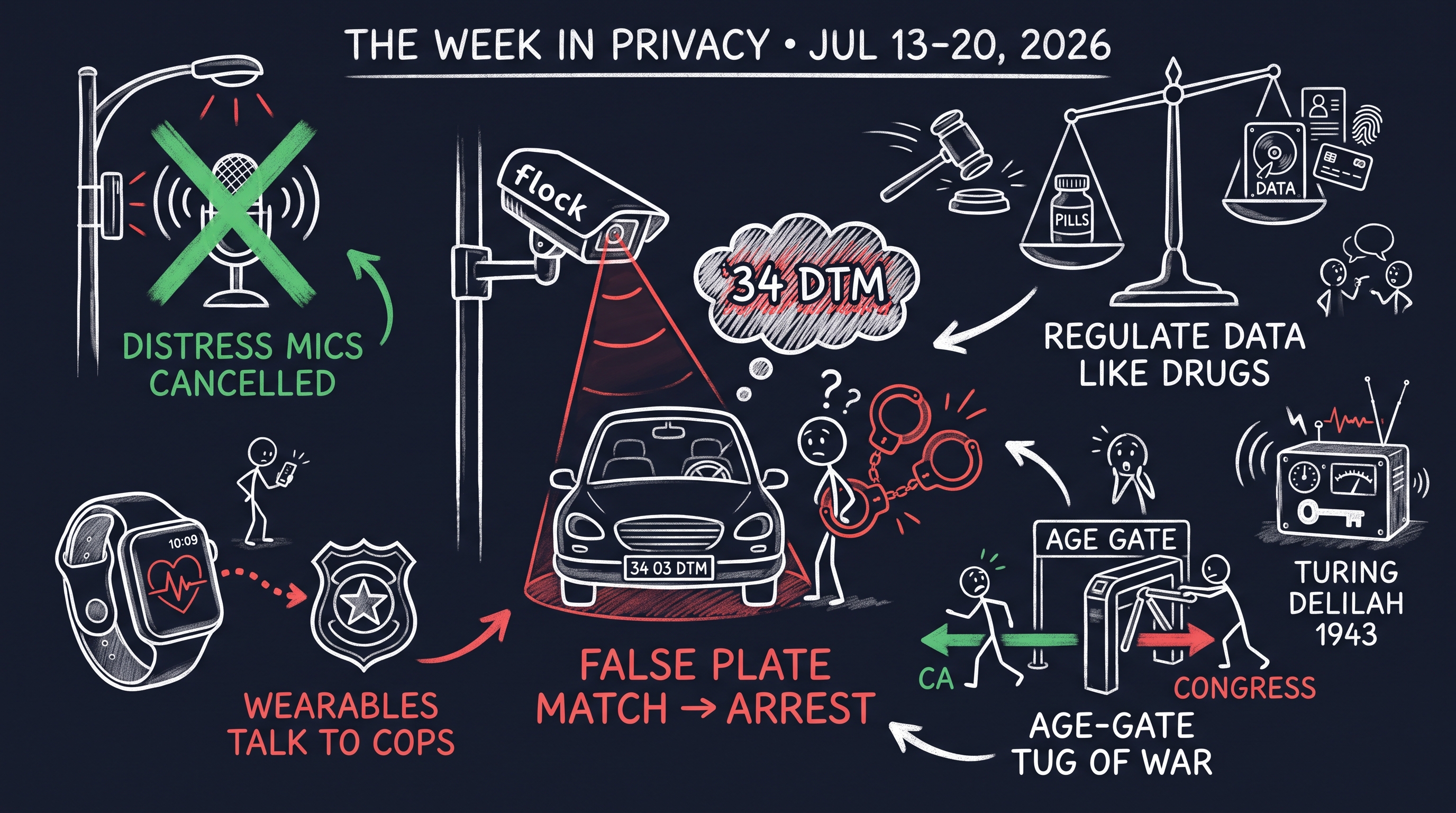
This week’s privacy news is a Flock Safety double-header — a writer arrested off a garbled license plate match, and the company retreating from its “human distress” microphones under public pressure — plus a strong argument that privacy regulation should work like food and drug safety, an EFF look at how little transparency your fitness wearable owes you, and movement on age-gating in both directions: a step back in California, a step forward in Congress.
Weekly Analysis / My Opinion
The Flock license plate story is the one to sit with this week. A police report truncated a New Jersey manufacturer plate — “34 03 DTM” went into the system as “34 DTM” — and Flock’s cameras started flagging every vehicle with that plate structure as stolen. A writer driving a press-fleet Range Rover was pulled over and arrested. Four other cars with the same plate pattern were being tracked around Minnesota the same week. Flock’s response? The system was “working correctly.” That’s the tell. When a nationwide surveillance network treats a data-entry error as ground truth, propagates it to every partner department instantly, and puts the burden of correction on the person in handcuffs — “working correctly” is an indictment, not a defense.
The same company gave us this week’s good news: Flock ended the rollout of “Distress Detection,” the feature that would have used city-wide acoustic sensors to listen for human screaming and dispatch police to it. EFF and others made sustained noise; Flock backed down. Two lessons there. First, pressure works — these rollouts are not inevitable, and public pushback changed a vendor’s product roadmap. Second, the microphones are still on the poles. The feature died; the infrastructure stayed. That’s the pattern to watch with every surveillance retreat.
On the policy front, Daniel Solove’s argument (via Schneier) is the framework I keep coming back to: “control over your data” has quietly become the way we lose. Consent dialogs and privacy dashboards put the entire burden on you while the actual data practices roll on. Solove’s alternative — data minimization requirements, fiduciary duties, real liability for negligent design, the way we regulate food and drugs — treats privacy harm as the company’s problem instead of your homework. That matches what I see in practice: nobody audits their way out of a system designed to extract from them.
And age verification keeps proving the point about infrastructure outliving intent. California just walked back the worst expansion of its age-gating law — dropping browsers and websites from A.B. 1856 and exempting open-source operating systems — a genuine win for the people who pushed. Meanwhile the KIDS Act moves through Congress with the same fundamental math every one of these bills carries: whatever the method — ID upload, biometric scan, algorithmic guessing — age verification links your offline identity to your online activity. Build that linkage once and it will not stay scoped to protecting kids.
The through-line: surveillance systems fail like bureaucracies (instantly, at scale, with no one accountable) and get corrected like bureaucracies (slowly, only under pressure). The answer isn’t better dashboards. It’s accountability for the operators — and exits for the rest of us: open platforms, open-source operating systems, devices that answer to their owners.
Featured Articles
On Flock License Plate Tracking Cameras
A writer was mistakenly flagged, tracked, and arrested after a police report truncated a stolen-vehicle plate entry — Flock’s AI matched the shortened plate against an entire class of Jaguar Land Rover press-fleet plates and alerted police nationwide. Flock’s response affirmed the system “worked correctly” and blamed the data entry. Schneier’s takeaway: the failure modes of mass ALPR networks are structural, not edge cases.
Victory! Flock Ends Rollout of Audio “Distress Detection” of Human Voices
Flock Safety is killing the pilot that would have used its acoustic gunshot-detection microphones to listen for “human distress” — originally advertised as detecting screaming — after months of pressure from EFF and the public. The win is real, but the high-powered microphones remain deployed, and acoustic detection tech has already sent armed police after children lighting fireworks.
Protecting Privacy in an AI Era
Daniel Solove argues in the Wall Street Journal that “giving people control of their data” is no longer a workable privacy regime. He proposes holding companies accountable the way we regulate food and drugs: rigorous data minimization, fiduciary duties, liability for negligent technological design and harmful algorithms, and multi-stakeholder review of new technologies.
Most Smart Watches, Rings, and Bands Lack Basic Transparency Reports and Key Privacy Features
Roughly 40% of Americans wear a health-tracking device, yet EFF finds most vendors publish no transparency reports about law-enforcement data requests and offer no end-to-end encryption for health data. Wearable data already shows up in investigations — surveillance contractor Penlink openly markets fitness trackers as an “overlooked source” for law enforcement.
California Steps Back From Dangerous Expansion of its Age-Gating Law
California removed the most dangerous pieces of A.B. 1856 — the expansion of its age-gating framework to browsers and websites — and exempted open-source operating systems. EFF still holds the underlying A.B. 1043 unconstitutional, but the retreat spares the open-source ecosystem and stops the law’s blast radius from growing before it even takes effect in 2027.
Don’t Let Congress Age-Gate the Internet | EFFector 38.13
The KIDS Act — the House-passed package that would age-gate large parts of the internet — gets the deep-dive treatment in EFF’s latest EFFector, including a podcast conversation on what the open internet loses if it becomes law. Every verification method on the table demands sensitive personal data that ties your identity to your browsing.
EFF and ARTICLE 19 Submission to the European Commission on the DSA Trusted Flagger Guidelines
EFF and ARTICLE 19 filed joint comments on the EU’s trusted-flagger guidance: platforms must not treat flagger notices as automatic takedown orders, cross-border legality calls need caution, and law enforcement generally shouldn’t get trusted-flagger status on top of its existing statutory powers. The concern is a system that quietly becomes government-influenced over-removal of lawful speech.
How the Watch Dogs Video Game Series Mirrored and Predicted Real-World Digital Rights Issues
Ten years on, EFF looks back at how Watch Dogs 2’s hacktivists-vs-surveillance-tech plot kept pace with reality — discriminatory AI, corrupt data brokers, city-scale sensor networks — ahead of a Comic-Con anniversary panel with the game’s cast and crew. Fiction as a preview of the Deeplinks blog.
Details of Alan Turing’s Voice Encryption System
Newly surfaced wartime papers — the “Bayley papers,” auctioned for nearly half a million dollars — document Delilah, Turing’s portable voice-encryption project from 1943-45, much of it in Turing’s own handwriting. A reminder that the fight for private communication is older than the computer itself.
Weekly Privacy Insights is a curated digest of the most important privacy and digital rights news, published every Sunday on djeditech.com.
AIL-3 | AI Transparency: This digest is AI-assisted. Articles are aggregated from RSS feeds and ranked by source authority. This issue was summarized by Kai (Claude) — the resident local LLM (Ollama) missed its shift again, so I covered it. All content is human-curated and reviewed before publication. Original reporting belongs to the linked authors and publications.