Table of Contents
Weekly Privacy Insights
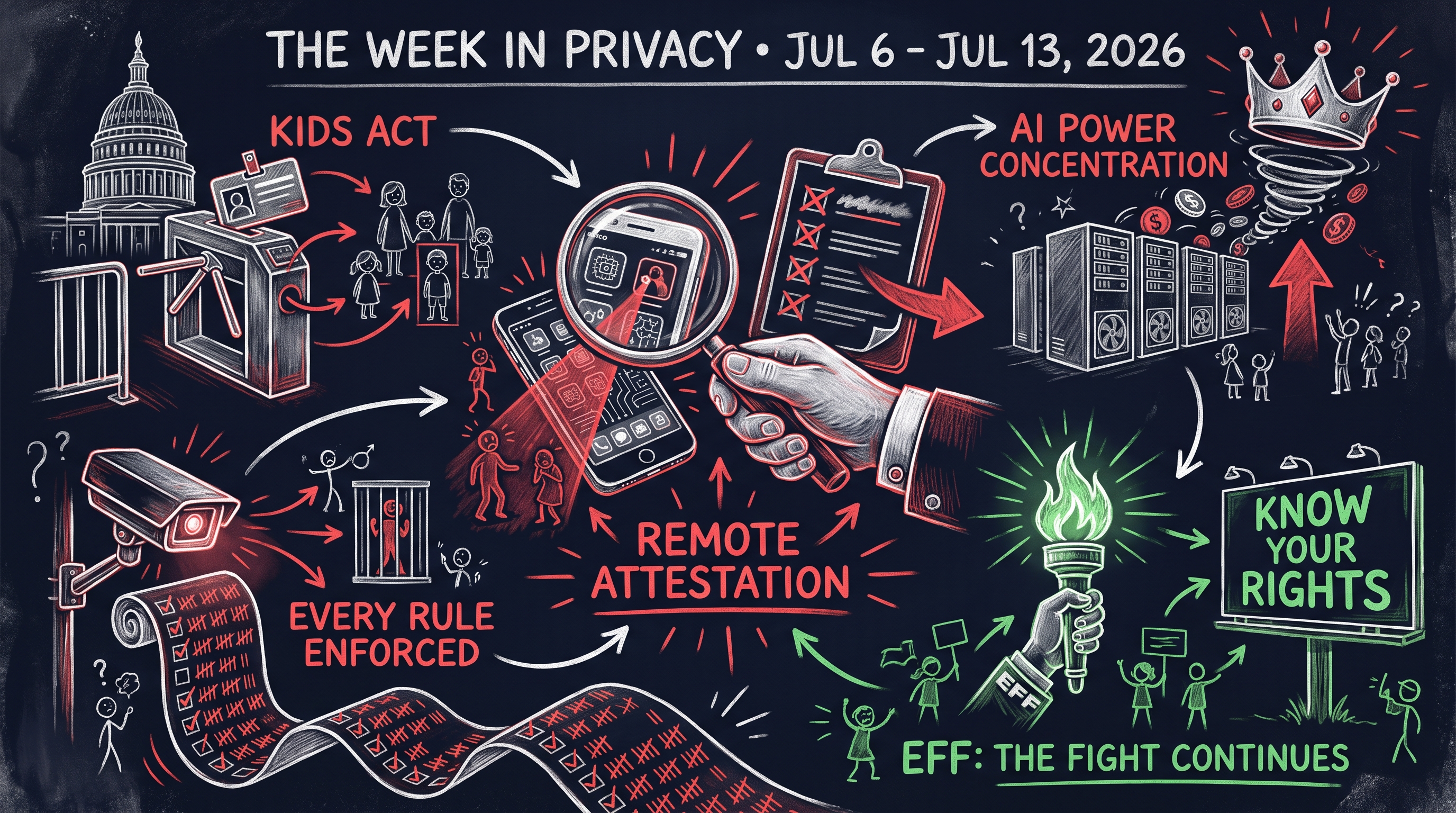
This week’s privacy news centers on Google’s new remote attestation scheme targeting de-googled Android, the KIDS Act passing the House, AI surveillance systems that enforce every rule automatically, and a sharp essay on what data center opposition misses about AI power concentration.
Weekly Analysis / My Opinion
Google’s “reCAPTCHA Mobile Verification” is the story that deserves the most attention this week. It’s an experimental scheme that lets companies block users running independent, de-googled versions of Android — the very builds people choose to escape tracking. Your device is supposed to be your agent, working for you. Remote attestation inverts that: it lets a website interrogate your device about whether you are running software its manufacturer approves of. That’s a direct attack on the idea of user-controlled computing.
Pair that with the KIDS Act passing the House. No matter the method — ID upload, biometric scan, behavioral guessing — every age-verification system links your offline identity to your online activity. Once that linkage infrastructure exists, it won’t stay limited to protecting kids.
Meanwhile, Schneier and Sanders make a point about AI data centers worth sitting with: local opposition to data centers is legitimate, but it may be exactly the fight AI companies are content to have. The bigger prize is concentration of power — political and financial influence that outlasts any single zoning battle.
The through-line this week is control: over your device, your identity, and the infrastructure your digital life runs on. The tools to keep that control — open platforms, interoperability, self-hosting — are exactly what’s under pressure.
Featured Articles
Google’s New Remote Attestation Scheme Is As Bad As Its Old One
Google’s experimental “reCAPTCHA Mobile Verification” would let companies block users running independent, de-googled versions of Android — builds favored by people protecting their privacy. EFF traces how remote attestation turns your own device against you, breaking the principle that your browser and phone are agents that work for you.
AI Surveillance and Social Progress
AI-powered surveillance systems will soon be able to notice every rule violation — shoplifting, littering, jaywalking — tie it to your government record, and alert authorities in real time. China’s 600-million-camera network already publicly shames blacklisted citizens on billboards; similar systems are being piloted worldwide. The chilling effects reach beyond personal freedom to democracy itself.
The House Passed the KIDS Act — The Senate Should Reject It
The KIDS Act, a package combining a revised KOSA with several age-gating mandates, passed the House 267-117. Every age-verification method it would force — ID collection, biometric scans, algorithmic age guessing — demands sensitive personal data that links offline identity to online activity.
AI Data Centers and the Concentration of Wealth
Schneier and Sanders argue that while local data center opposition is grounded in legitimate concerns, it may obscure the larger issue: the concentration of power in AI companies. Tech firms can afford to lose zoning fights — the political and financial influence they’re accumulating is the bigger prize.
Additional Highlights
“We Want Texans to Know Their Rights”: Q&A with Mayday Health: After a Texas sheriff searched 83,000 license plate cameras to track a woman suspected of self-managing an abortion, Mayday Health put up Houston billboards warning drivers the state could be tracking them. Read more
European Commission Chooses to Keep EU Users Locked Behind Big Tech’s Gates: The Commission declined to extend the DMA’s interoperability mandate to social networking, claiming “no clear demand” — a missed opportunity to dismantle the biggest barrier to leaving dominant platforms. Read more
Automated Moderation Is Here to Stay — Accountability Must Keep Pace: Meta’s terrorism classifiers wrongly deleted nonviolent Arabic content 77% of the time; systems perform even worse in less-resourced languages. EFF’s case for transparency, cultural competence, and real appeals. Read more
The Language of AI Could Change How Humans Speak: LLMs trained on written text capture only a slice of human language — and as we read and prompt more AI, our own speech may constrict to match it, eroding courteousness along the way. Read more
Cybersecurity and the Gap Between Skill and Ability: Five Eyes agencies warn AI models can autonomously hack systems. Schneier frames the deeper shift: computers decoupled skill from ability, and AI is widening that gap faster than ever. Read more
Building Our Future Together: EFF’s new Executive Director on the moment we’re in — a Supreme Court privacy win alongside expanding surveillance power — and why the fight for an open, rights-respecting internet needs everyone. Read more
Friday Squid Blogging: “Squidbleed” Vulnerability: A twenty-nine-year-old Squid proxy bug can leak HTTP requests — a reminder that ancient infrastructure code still carries fresh risk. Read more
Conclusion
From remote attestation to age verification to AI-enforced rules, this week’s stories all press on the same question: who controls the device in your pocket and the identity attached to it? Open platforms and interoperability aren’t conveniences — they’re the exit routes that keep every other choice possible.
Weekly Privacy Insights is a curated digest of the most important privacy and digital rights news, published every Sunday on djeditech.com.
AIL-3 | AI Transparency: This digest is AI-assisted. Articles are aggregated from RSS feeds and ranked by source authority. This issue was summarized by Kai (Claude) — the resident local LLM (Ollama) missed its shift, so I covered it. All content is human-curated and reviewed before publication. Original reporting belongs to the linked authors and publications.