Weekly Privacy Insights: June 15, 2026 – June 22, 2026
- Rob Pratt
- Privacy , Weekly insights
- June 22, 2026
Table of Contents
Weekly Privacy Insights
This week’s stories share a common thread: governments racing to expand surveillance—and to weaken the protections standing in their way—almost always under the banner of safety. From Canada’s push to break encryption to the UK’s sweeping age-verification ambitions, the pattern repeats: broad mandates, thin evidence, and the public’s privacy treated as an acceptable casualty. The bright spots came from the courts and the legislature, where a few proposals actually moved in the right direction.
Weekly Analysis / My Opinion
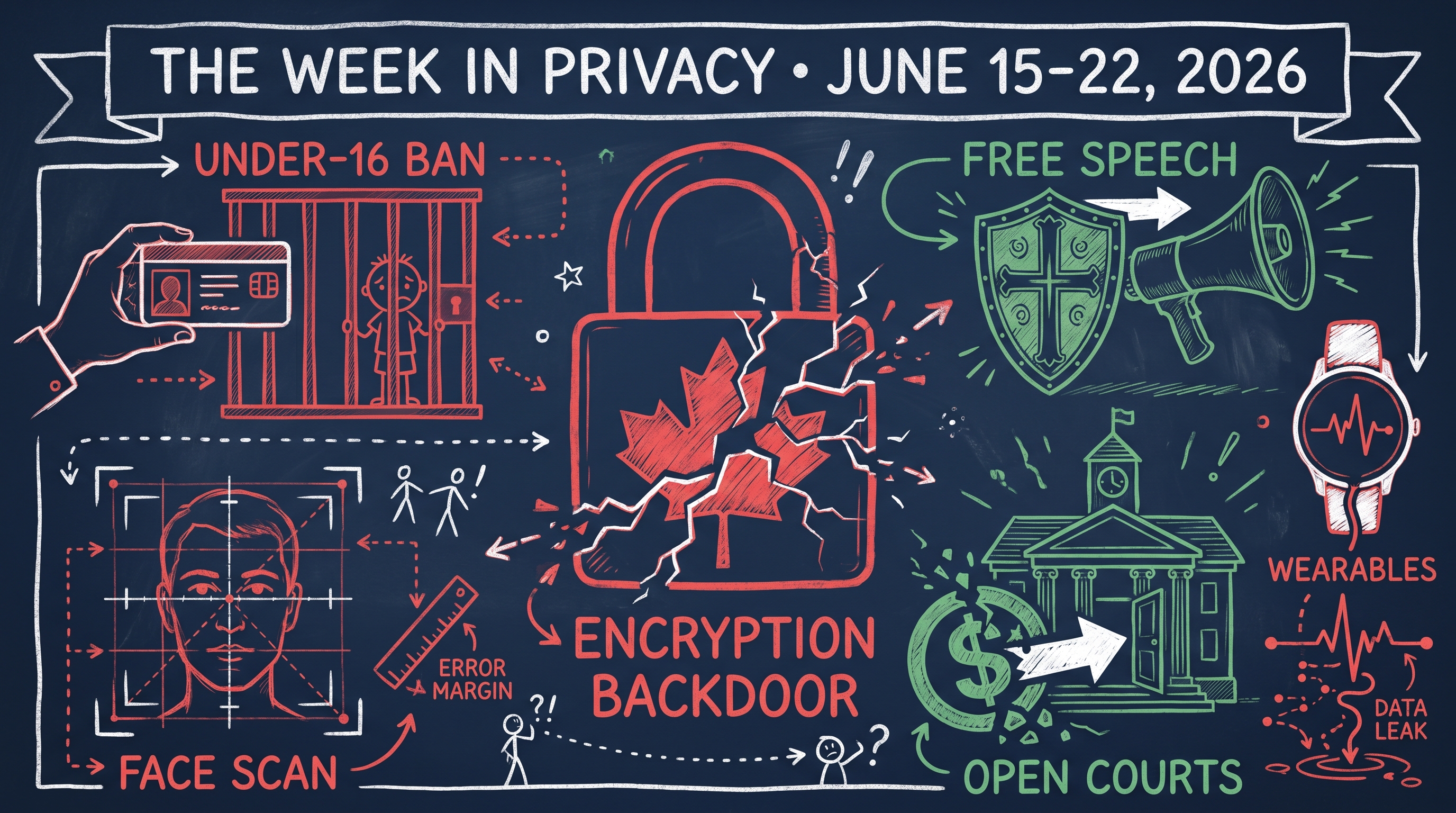
The most serious development is Canada’s Bill C-22, the so-called “Lawful Access” bill. Buried in it is a mechanism that would let the Ministry of Public Safety compel companies to build backdoors—effectively breaking encryption—plus metadata retention and expanded data-sharing with foreign governments. What’s most telling is how it’s moving: rushed toward a vote with no serious debate, and with the backdoor provision deliberately shielded from independent scrutiny. When Signal, Apple, Google, and multiple VPN providers all say they’d sooner cut features or leave a market than comply, that’s not industry whining—that’s the canary. Encryption either works for everyone or it works for no one; there is no “good guys only” backdoor.
Across the Atlantic, the UK is running the same playbook on a different front. The under-16 social media ban and the plan to use Facial Age Estimation on asylum-seeking children both hinge on the same broken premise: that you can reliably verify age without surveilling everyone. You can’t. Age-gating forces all users to prove who they are before they can speak or read, and face-estimation tools carry admitted error margins of years—wider still for women, people of color, and traumatized children. These are policies built on panic, and they trade a real, universal loss of privacy for a benefit that the evidence simply doesn’t support.
Closer to everyday life, the wearables story is a preview of where biometric surveillance is headed. If a coach—or a sportsbook—can pull your sleep and heart-rate data, so can an employer, an insurer, or anyone negotiating against you. The good news this week came from two corners: the bipartisan JAWBONE Act would finally give people a way to fight back when the government strong-arms platforms into censoring lawful speech, and the Open Courts Act would tear down PACER’s paywall so the public can actually read the law it’s governed by. Worth watching both.
Featured Articles
1. Canada Is Forging Ahead with Its Dangerous Surveillance Bill: Bill C-22 would force companies to create encryption backdoors, mandate metadata retention, and expand data-sharing with foreign governments—and it’s being jammed through with no real debate. Signal, Apple, Google, and several VPN providers oppose it. Read more
2. The UK’s New Under-16 Social Media Ban Will Cause More Harm Than It Prevents: A ban set for Spring 2027 would require every user to prove their age before accessing major platforms, with no reliable privacy-preserving way to do it—cutting young people off from educational and community content in the process. Read more
3. Professional Athletes and Wearables: Biometric data from wearables creates serious privacy stakes—coaches surveilling players’ sleep and heart rate, leagues eyeing commercialization, and sharp bettors hungry for an edge. A clear look at where biometric surveillance is heading for all of us. Read more
Additional Highlights
EFF Joins 60+ Groups Urging the UK to Halt Face Estimation at the Border: A coalition warns that deploying Facial Age Estimation on asylum-seeking children is discriminatory, inaccurate (error margins around 2.5 years), and built on undisclosed data. Read more
A New Bill Takes Aim at Government Pressure to Silence Lawful Online Speech: The bipartisan JAWBONE Act, from Senators Cruz and Wyden, creates a federal cause of action against officials who coerce platforms into censoring First-Amendment-protected speech. Read more
Court Records Should Be Free: EFF backs the Open Courts Act of 2026, which would eliminate PACER’s fees—more than $150M collected annually for access to public documents—and modernize the federal courts’ filing systems. Read more
Anthropic’s Fable and the State of AI: Bruce Schneier on AI capability creep and export controls—arguing the problem isn’t any single model but the general trend, and that the “harness” around a model matters as much as the model itself. Read more
Field Notes from a Year of OPSEC Training: EFF details its pro bono operational-security work with at-risk communities—how it differs from traditional pentesting and centers the needs of human rights defenders and movement workers. Read more
Call for Submissions: Digital Pride: EFF and the Queer Arts Collective invite writing and visual art at the intersection of digital justice and queer expression. Submissions due June 30, 2026. Read more
EFF Thanks SerpApi for Helping Us Protect Free Speech Online: A look at the litigation and policy work supported by long-time donors—from suing DHS over social media surveillance to defending Section 230. Read more
Friday Squid Blogging: Victims of Unregulated Squid Fishing: Schneier’s weekly open thread, this time on the toll unregulated squid fleets take on dolphins, sharks, turtles, and human workers. Read more
AIL-3 | AI Transparency: This digest is AI-assisted. Articles are aggregated from RSS feeds, ranked by source authority, and summarized using a local LLM (Ollama). All content is human-curated and reviewed before publication. Original reporting belongs to the linked authors and publications.