Table of Contents
Weekly Privacy Insights
This week’s privacy news is dominated by concerns over government surveillance, AI safety, and digital rights. As we navigate the complex landscape of online security, it’s essential to stay informed about the latest developments.
Weekly Analysis / My Opinion
The past week has seen a significant push for reform in Section 702, a mass spying program that allows the National Security Agency (NSA) to collect and store vast amounts of data on individuals. The EFF and other civil liberties advocates have been working tirelessly to bring about meaningful change, but there is still much work to be done. It’s crucial that we continue to push for transparency and accountability in government surveillance practices.
Featured Articles
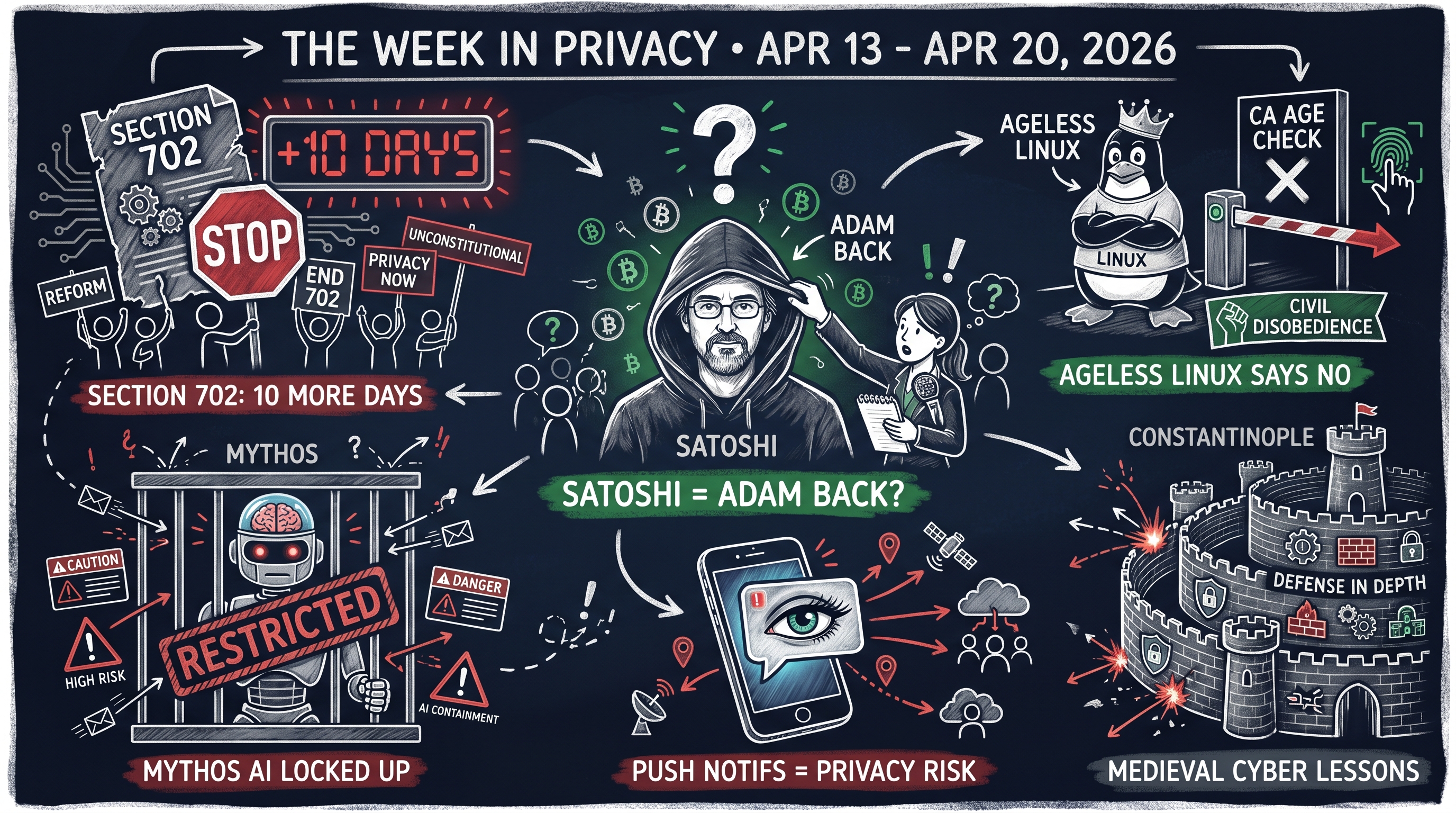
Is “Satoshi Nakamoto” Really Adam Back?
The New York Times has published an article suggesting that the inventor of Bitcoin, Satoshi Nakamoto, may be none other than cypherpunk Adam Back. While the evidence presented is compelling, it’s essential to approach this story with a critical eye and consider the potential implications for the cryptocurrency community.
Read more: https://www.schneier.com/blog/archives/2026/04/is-satoshi-nakamoto-really-adam-back.html
Ageless Linux: Civil Disobedience Through Operating System
The Ageless Linux project has declared noncompliance with California’s Digital Age Assurance Act, which requires age verification for certain online activities. This move highlights the tension between government regulations and individual freedoms in the digital age.
Read more: https://www.sambent.com/ageless-linux-civil-disobedience-through-operating-system/
Keep Pushing: We Get 10 More Days to Reform Section 702
The EFF has reported on the latest developments in the push for reform in Section 702. With a 10-day extension, advocates are urging Congress to pass meaningful legislation that prioritizes transparency and accountability.
Read more: https://www.eff.org/deeplinks/2026/04/keep-pushing-we-get-10-more-days-reform-section-702
Additional Highlights
Mythos and Cybersecurity: The AI model Mythos has been restricted due to its ability to find and exploit software vulnerabilities. While this is a step in the right direction, there are concerns about the lack of transparency in the decision-making process. Read more: https://www.schneier.com/blog/archives/2026/04/mythos-and-cybersecurity.html
Stop New York’s Attack on 3D Printing: The proposed budget in New York includes provisions that would require 3D printers to run print-blocking censorware. This move is seen as a threat to digital rights and innovation. Read more: https://www.eff.org/deeplinks/2026/04/stop-new-yorks-attack-3d-printing
How Push Notifications Can Betray Your Privacy (and What to Do About It): A recent report has highlighted the potential risks of push notifications in compromising user privacy. This article provides guidance on how to mitigate these risks. Read more: https://www.eff.org/deeplinks/2026/04/how-push-notifications-can-betray-your-privacy-and-what-do-about-it
Human Trust of AI Agents: Research has shown that humans tend to trust AI agents more than they should, which can lead to vulnerabilities in decision-making processes. Read more: https://www.schneier.com/blog/archives/2026/04/human-trust-of-ai-agents.html
EFF Calls on Kuwait to Release Journalist Ahmed Shihab-Eldin: The EFF has called for the release of journalist Ahmed Shihab-Eldin, who was arrested in Kuwait while visiting family. Read more: https://www.eff.org/deeplinks/2026/04/eff-calls-kuwait-release-journalist-ahmed-shihab-eldin
Digital Hopes, Real Power: The Rise of Network Shutdowns: This article explores the growing trend of network shutdowns and their impact on digital rights. Read more: https://www.eff.org/deeplinks/2026/04/digital-hopes-real-power-rise-network-shutdowns
Defense in Depth, Medieval Style: This article examines the defensive systems used by Constantinople and draws parallels with modern cybersecurity practices. Read more: https://www.schneier.com/blog/archives/2026/04/defense-in-depth-medieval-style.html
Conclusion
This week’s privacy news has highlighted the need for continued vigilance and advocacy in the face of government surveillance, AI safety concerns, and digital rights issues. By staying informed and pushing for change, we can work towards a more secure and equitable online environment.
Weekly Privacy Insights is a curated digest of the most important privacy and digital rights news, published every Sunday on djeditech.com.
AIL-3 | AI Transparency: This digest is AI-assisted. Articles are aggregated from RSS feeds, ranked by source authority, and summarized using a local LLM (Ollama). All content is human-curated and reviewed before publication. Original reporting belongs to the linked authors and publications.