Weekly Privacy Insights: February 23, 2026 – March 2, 2026
- Rob Pratt
- Privacy , Weekly insights
- March 2, 2026
Table of Contents
Weekly Privacy Insights
This week’s privacy news highlights the ongoing struggle for digital rights and the increasing sophistication of surveillance technologies. As governments and corporations continue to consolidate power over our personal data, it’s essential to stay informed about the latest developments and take action to protect our online lives.
Weekly Analysis / My Opinion
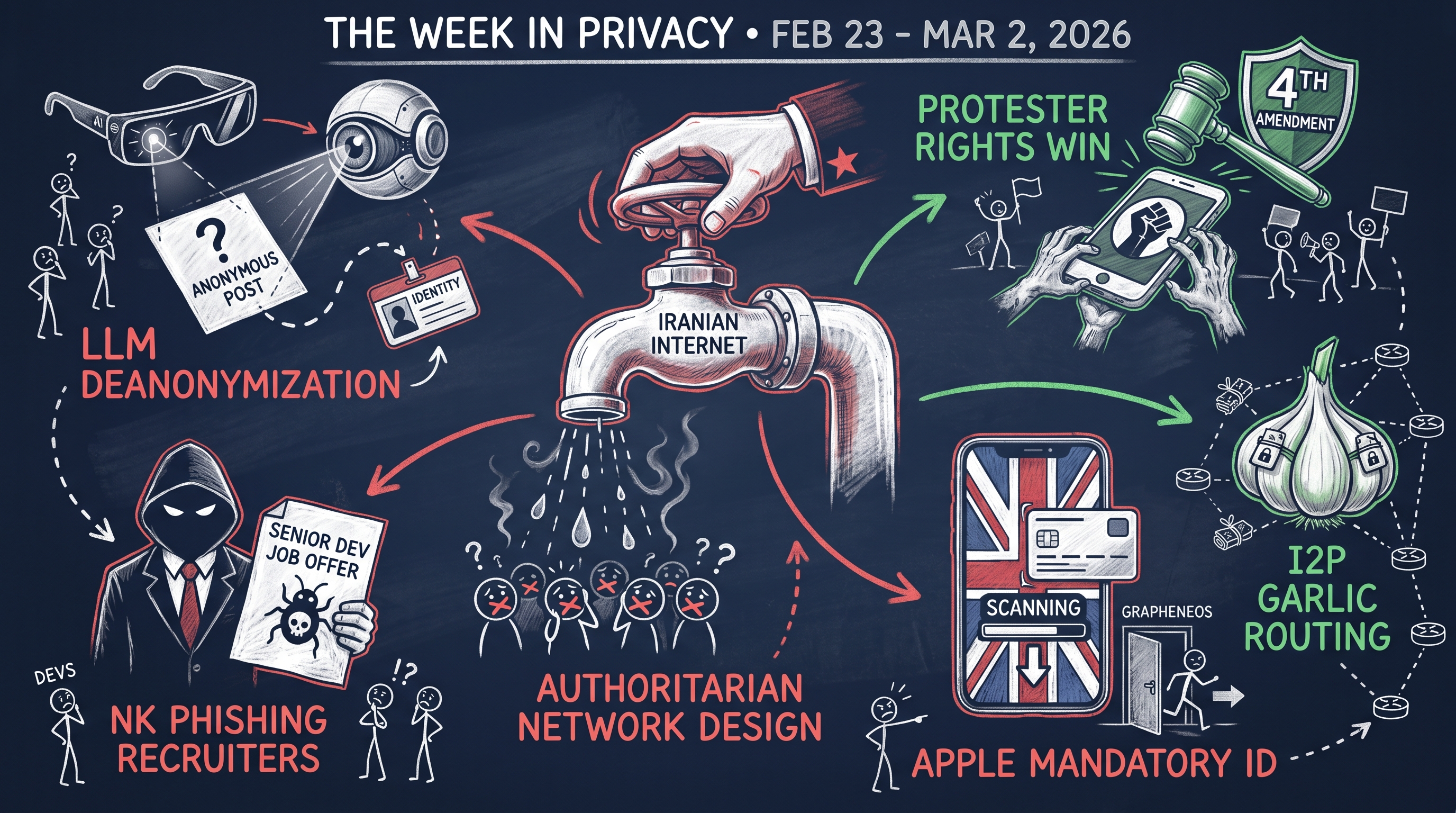
The Iranian government’s recent internet shutdown is a stark reminder of the dangers of authoritarian network design. By treating connectivity as a faucet that can be turned off at will, governments assert their power over citizens’ right to speak, assemble, and access information. This escalation marks a strategic shift in modern authoritarianism, where the ability to disconnect a population is used to silence dissenting voices.
The use of LLMs for de-anonymization raises significant concerns about online privacy. As these models become increasingly sophisticated, they can infer sensitive information from seemingly anonymous online posts. This highlights the need for robust data protection measures and the importance of understanding the limitations of AI-powered surveillance.
Featured Articles
1. Iran’s Two-Tiered Internet: A Threat to Digital Rights: The Iranian government’s internet shutdown has disrupted local infrastructure, including mobile networks, text messaging services, and landlines. This marks a significant escalation in authoritarian network design, where connectivity is treated as a revocable right.
2. LLM-Assisted Deanonymization: Researchers have demonstrated that Large Language Models (LLMs) can infer sensitive information from anonymous online posts, raising concerns about online privacy.
3. Phishing Attacks Against Programming Job Seekers: North Korean hackers are posing as company recruiters to entice job candidates into participating in coding challenges, which install malware on their systems.
4. Victory for Protesters’ Rights: Tenth Circuit Finds Fourth Amendment Doesn’t Support Broad Search of Devices and Digital Data: The U.S. Court of Appeals for the Tenth Circuit overturned a lower court’s dismissal of a challenge to sweeping warrants to search protesters’ devices and digital data.
Additional Highlights
- Dread Pays $1,000 XMR for Good Writing: Dread is running a writing contest with $1,750 in Monero prizes and one specific ban: AI-generated content.
- Tails 7.5 Ships New Tor Circuit Encryption: Tails 7.5 upgrades to Tor 0.4.9.5 with Counter Galois Onion encryption and patches over 30 high-severity Firefox vulnerabilities through Tor Browser 15.0.7.
- Apple’s Mandatory ID… GrapheneOS is the Exit: Apple rolled identity verification into iOS 26.4 for UK users under the Online Safety Act, requiring credit card scans or government photo ID to confirm users are over 18.
- Garlic Routing: How I2P Bundles Messages to Frustrate Surveillance: The unidirectional tunnel requirement in I2P means a simple request-response involves four distinct paths, and garlic routing optimizes this architecture by packaging multiple messages together for efficient transport.
- National Book Tour for Cindy Cohn’s Memoir, ‘Privacy’s Defender’: EFF Executive Director Cindy Cohn will launch her memoir, Privacy’s Defender: My Thirty-Year Fight Against Digital Surveillance (MIT Press, March 10), with events in San Francisco and Berkeley.
- LLMs Generate Predictable Passwords: Researchers have demonstrated that LLMs can generate predictable passwords, highlighting the need for robust password generation mechanisms.
- Friday Squid Blogging: Squid Fishing in Peru: Peru has increased its squid catch limit, and the article mentions giant squid, but it’s unlikely they mean that.
Conclusion
This week’s privacy news highlights the ongoing struggle for digital rights and the increasing sophistication of surveillance technologies. As governments and corporations continue to consolidate power over our personal data, it’s essential to stay informed about the latest developments and take action to protect our online lives.
Weekly Privacy Insights is a curated digest of the most important privacy and digital rights news, published every Sunday on djeditech.com.
AIL-3 | AI Transparency: This digest is AI-assisted. Articles are aggregated from RSS feeds, ranked by source authority, and summarized using a local LLM (Ollama). All content is human-curated and reviewed before publication. Original reporting belongs to the linked authors and publications.