Table of Contents
They Didn’t Deny Your Claim. They Just Paid You Half of What It Costs.
The most expensive insurance problem contractors face isn’t denial. It’s the lowball payment nobody fights.
This is Part 3 of the insurance series. Part 1 covered AI replacing adjusters. Part 2 covered fighting denials. This one is the piece most contractors never talk about — because it doesn’t feel like theft until you do the math.
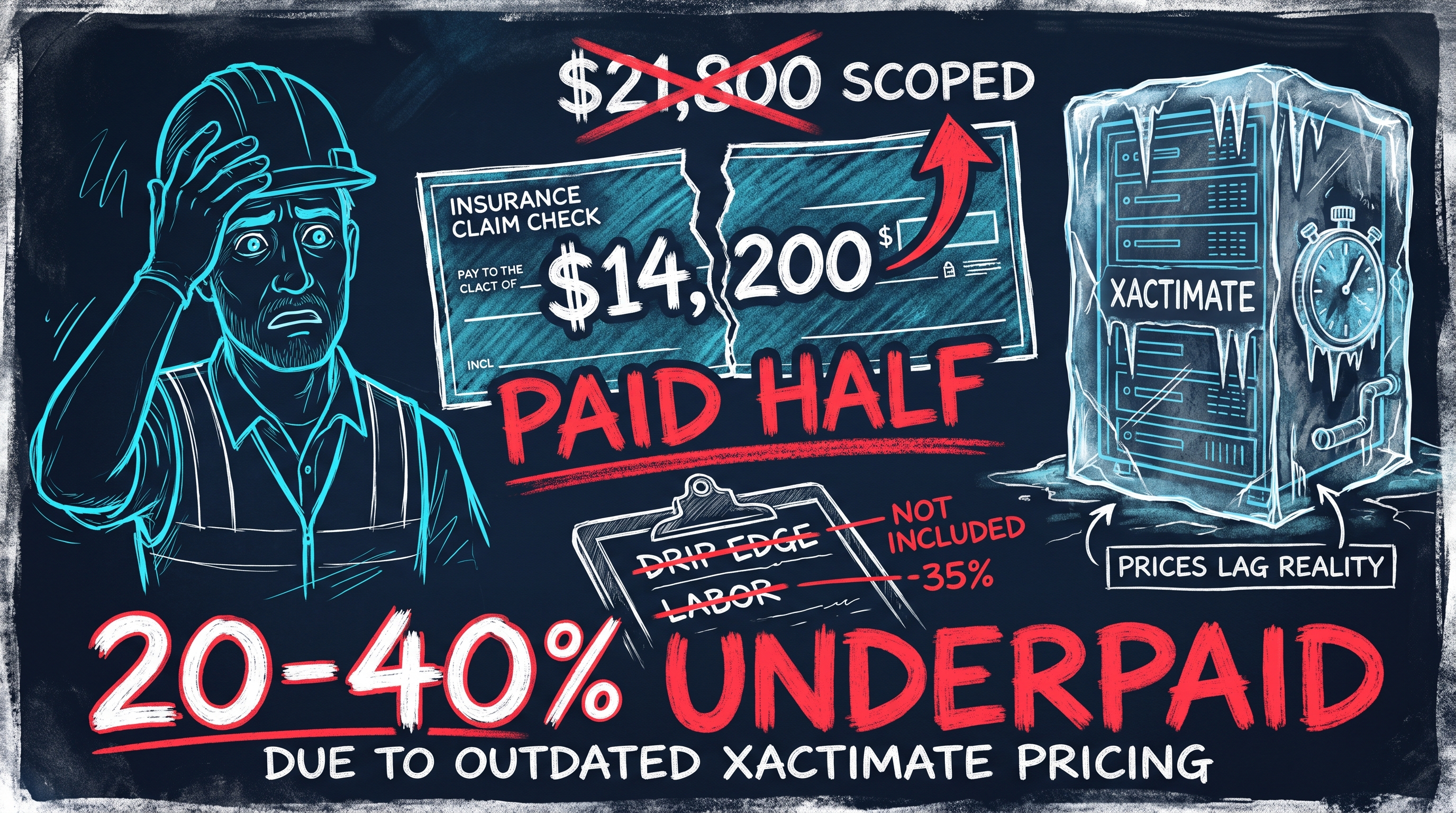
The check came in for $14,200.
You scoped the job at $21,800. Replacement cost on the materials alone, at current lumber prices, is $16,400. The adjuster didn’t deny anything. He said the work was valid. He said the damage was covered. He just “adjusted” your numbers.
Detachment labor: cut by 35%. Drip edge: “not included in scope.” Starter strip: “already covered in shingle install.” Ice and water shield: paid for 60% of what the code requires in your region. Waste factor: calculated at 8% on a hip roof with three dormers.
You’ve seen this before. You’ll see it again next week. And the week after that.
Most contractors cash the check.
This Isn’t an Accident
Underpayment isn’t a pricing disagreement. It’s not an honest mistake about what materials cost. It’s a deliberate, systematic business practice.
Insurance carriers use their own pricing databases — primarily Xactimate — that are updated on a schedule that conveniently lags behind actual material costs. When lumber spiked 40% during supply chain disruptions, Xactimate pricing didn’t follow. When labor rates in your market went up because every contractor in a three-state radius was chasing the same storm damage, the database stayed flat.
You bid at what it actually costs to do the work. The adjuster prices it at what some database says it should cost in an imaginary average market. The gap between those two numbers is the money that stays in the carrier’s pocket.
Industry estimates put average underpayment at 20-40% per claim. On a $25,000 job, that’s $5,000 to $10,000 walking out the door — and the carrier is counting on you being too busy to fight it.
The Specific Tactics They Run
I’ve been in this industry for twenty years. The underpayment playbook has been consistent since before I started.
Waste factor manipulation. Carriers calculate shingle waste at 10-12% as a default. On a hip roof with multiple facets, valleys, and architectural features, actual waste runs 15-20%. The difference on a 40-square job is 3-4 squares of material you paid for out of your margin.
Missing line items. Starter strip, drip edge, ice and water shield, ridge cap, flashing, pipe boots — every one of these gets “overlooked” or “already included” in the adjuster’s scope. They weren’t overlooked. They were removed.
Below-market labor rates. Your crew costs what it costs. The adjuster prices labor using regional averages from a database. Your actual labor costs are irrelevant to the calculation.
Depreciation on non-depreciable items. Adjusters apply depreciation to code-required upgrades that don’t depreciate because they’re current building requirements. This one is borderline illegal in several states and contractors almost never challenge it.
Each one is a small fight. Add them up and you’re looking at the difference between a profitable job and a break-even one.
What This Actually Costs You Annually
Run your numbers.
If you do $1.5 million in insurance-related work annually and average underpayment is running 25%, you’re leaving $375,000 on the table every year. Not because you got denied. Because you got paid less than what the work costs and accepted it.
Most contractors don’t track this because they price the job at the Xactimate number, do the work, and move on. The actual cost of underpayment is invisible — absorbed into thinner margins, covered by the next job, gradually eroding a business that looks profitable but is working harder than it should be.
Two Types of Contractors
There are contractors who price insurance jobs at the Xactimate estimate, do the work, absorb the shortfall, and slowly wonder why margins keep eroding even as revenue grows.
And there are contractors who treat every insurance claim as an invoice that needs to be verified, supplemented, and closed at the correct number. Their per-job margin runs 20-30% higher on the same types of work.
The second group isn’t smarter or more aggressive. They built a system.
Next: How Smart Contractors Stopped Eating Insurance Shortfalls - The documentation and supplement workflow that recovers 15-25% more per claim.
P.S. — Ready to calculate what underpayment is costing you annually? A 60-minute Construction Automation Strategy Session ($150, credited toward implementation) maps your current claims workflow and puts a number on what you’re leaving behind.
AIL-3 | AI Transparency: This article was drafted with AI assistance and reviewed, edited, and approved by the author. All recommendations are based on 20 years of experience in the roofing and construction industry.