Table of Contents
The $50,000 Salary Trap: Why “Free” Administrative Work Is Killing Your Construction Business
You’re paying your office manager $50,000 per year to handle estimates, scheduling, and customer communications. When someone suggests automation to save time on manual data entry, your gut reaction is “Why would I pay for that? Sarah’s already on salary – her time doesn’t cost me anything extra.” I thought the exact same thing for years, until I realized this mindset was costing me six figures annually.
The Real Cost of “Free” Administrative Time
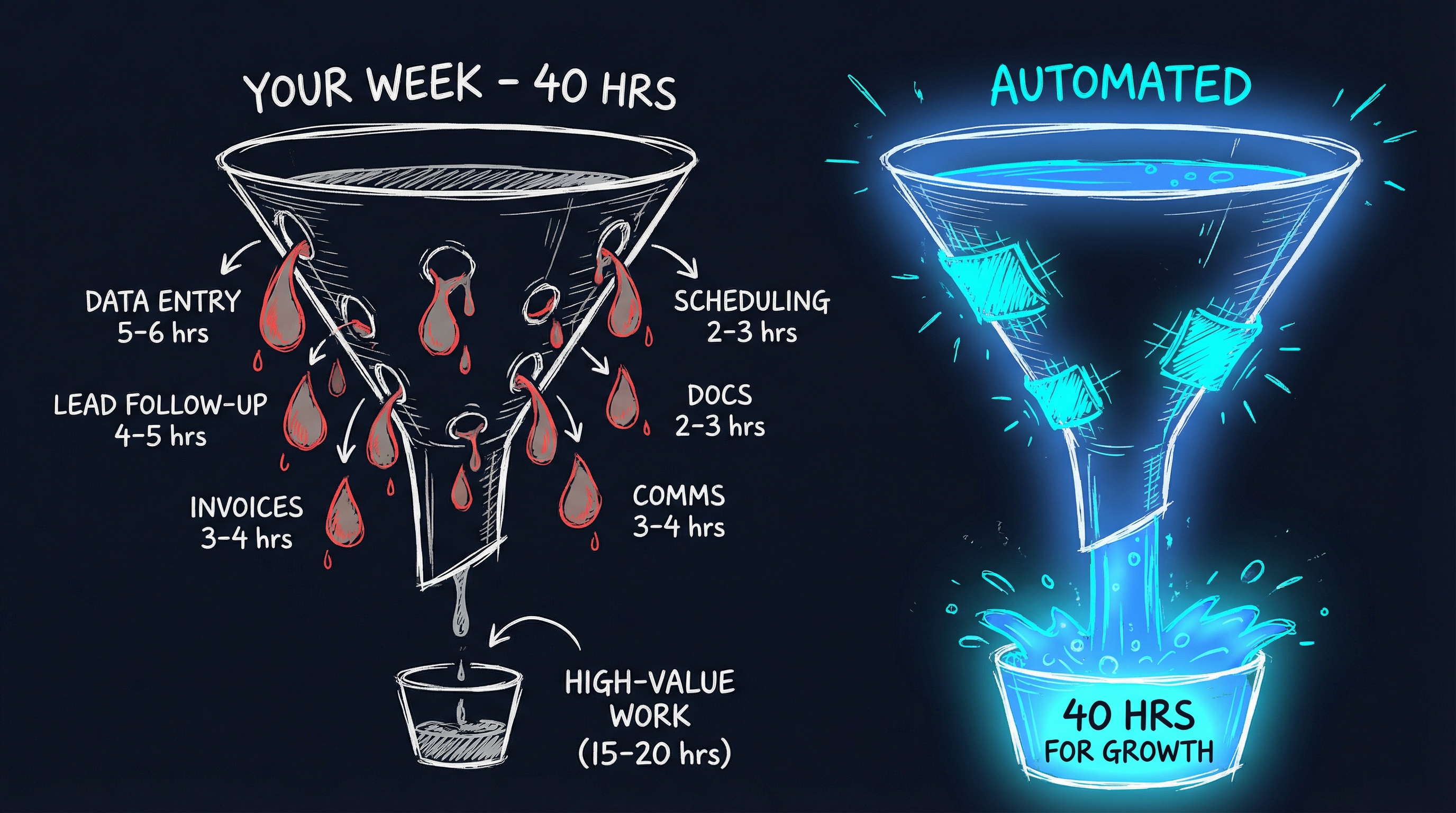
Here’s what that “free” salaried time actually costs you. Let’s say your office manager spends 2 hours daily on repetitive tasks: re-entering customer data from paper forms into your estimating software, manually creating work orders from approved estimates, and chasing down project photos to update customers.
That’s 520 hours annually of administrative work that could have been spent following up on leads, managing crew schedules, or coordinating with suppliers. At $25/hour value (conservative for skilled administrative work), you’re burning $13,000 yearly on data entry tasks that automation could eliminate entirely.
But here’s the real killer: while Sarah’s doing data entry, your leads are sitting in voice mail longer, estimates are delayed, and customer communications lag. In construction, speed wins contracts. When a homeowner calls five roofers about storm damage, the contractor who responds first – with a professional, detailed estimate – typically gets the job.
Manual Operations vs. Automated Efficiency
Most contractors handle a new lead like this: Customer calls, you write details on a notepad, later transcribe information into your CRM, then re-enter the same data into your estimating software, create a separate file for photos and documents, manually schedule the estimate appointment in another system, and finally create a work order if the estimate gets approved.
Total time: 45-60 minutes of administrative work per lead, spread across multiple touchpoints.
Here’s what the same process looks like with automation: Customer submits online inquiry (or phone call gets automatically logged), system creates customer record, estimates template auto-populates with customer information, photos upload directly to customer file, approved estimates automatically generate work orders, and scheduling updates trigger customer notifications.
Total time: 5-10 minutes of review and approval.
The automated contractor responds to inquiries within minutes while the manual contractor is still figuring out where they wrote down the customer’s phone number. Guess who sounds more professional and gets more jobs?
Why This Cost Me $80,000 Before I Got Smart
I used to think exactly like you do about salaried administrative work. My office manager Lisa was handling everything manually, and since I was paying her $45,000 regardless, automation seemed like an unnecessary expense.
Then I tracked our actual lead conversion rates and response times. We were losing 30% of potential jobs simply because competitors responded faster with more professional-looking estimates. On $400,000 in annual revenue, that’s $120,000 in lost opportunities.
After implementing our Growth Package automation systems, our response time dropped from hours to minutes. Lead conversion increased by 25%, and Lisa could focus on higher-value activities like project coordination and customer relationship management instead of data entry. The system paid for itself in four months through increased efficiency and revenue, then generated an additional $80,000 that first year.
What’s Available Right Now (Not Someday)
Today’s construction automation isn’t rocket science. Here’s what you can implement immediately:
Lead Management Automation: Web forms that automatically create customer records and trigger instant email responses with initial project information.
Estimate Integration: Systems that pull customer data into professional estimate templates without re-typing anything.
Photo Management: Mobile apps where crew photos automatically organize by job and customer, with instant customer access.
Scheduling Coordination: Calendar systems that show real-time crew availability and let customers book estimate appointments online.
Work Order Generation: Approved estimates that automatically create detailed work orders with materials lists and crew assignments.
Each of these eliminates 30-60 minutes of manual work per project while making your operation look bigger and more professional than competitors still using paper systems.
Two Types of Contractors Are Emerging
There are increasingly two distinct types of construction businesses in every market: those still operating on manual processes with “free” salaried administrative time, and those leveraging automation to respond faster, look more professional, and scale efficiently.
The manual contractors think they’re saving money by avoiding automation costs. Meanwhile, automated contractors are capturing market share with faster response times, professional presentations, and the ability to handle more volume without proportional staff increases.
This gap widens monthly. The longer you wait, the further behind you fall, and the harder it becomes to catch up with competitors who made the switch early.
Your Next Step: Free Automation Assessment
If you’re still thinking “my office staff is already on salary, so their time is free,” I’d like to offer you a 60-minute Construction Automation Strategy Session ($150, credited toward implementation). We’ll examine your current administrative workflows and calculate exactly what manual processes are actually costing you in lost revenue and growth opportunities.
This is a premium consultation where we’ll design your custom automation roadmap and show you the exact ROI timeline for your business.
CLICK HERE TO SCHEDULE YOUR STRATEGY SESSION
Stop Competing With One Hand Tied Behind Your Back
The contractors who embrace automation now will dominate their markets over the next five years. Those clinging to manual processes because “salaried time is free” will find themselves constantly losing to faster, more professional competitors.
Which type of contractor do you want to be in 2026?
Frequently Asked Questions
How do I calculate the real cost of administrative work my salaried employees are doing?
Multiply hours spent on administrative tasks by what that person could be earning doing revenue-generating work instead. If your office manager spends 20 hours weekly on manual paperwork but could be handling customer service that generates $5,000 in additional monthly revenue, that’s $60,000 in annual opportunity cost beyond their salary.
Won’t automation cost more than just having my employees do the work?
Initial automation investment of $15,000-$30,000 typically breaks even in 6-12 months when you factor in both time savings AND increased capacity. Unlike salary costs that recur forever, automation is a one-time investment that continues delivering value. Plus, your employees can focus on growth activities instead of administrative busy work.
What if my office manager is resistant to automation?
Top performers typically embrace automation because they’re frustrated spending time on repetitive tasks instead of meaningful work. Frame it as “we’re automating the boring stuff so you can focus on what you’re actually good at.” Most resistance comes from fear of job loss - make it clear automation enhances their role rather than replacing it.
How much administrative work can actually be automated in construction?
Estimate creation, customer follow-ups, scheduling, invoicing, payment tracking, progress updates, and document management can all be largely automated. Expect 70-85% of routine administrative tasks to be automatable, freeing up your team for client relationships, problem-solving, and business development that actually requires human expertise.
What’s the first step to reducing this administrative burden?
Start with a 60-minute Construction Automation Strategy Session ($150, credited toward implementation) where we map exactly how much time your team spends on which administrative tasks, calculate your real opportunity cost, and identify the highest-impact automation opportunities for your specific workflow.
P.S. The best part about construction automation? Your competitors can’t copy your systems overnight. Once you’re operating faster and more professionally, it takes them months to catch up – giving you a sustained competitive advantage in your market.
AIL-3 | AI Transparency: This article was drafted with AI assistance and reviewed, edited, and approved by the author. All recommendations are based on 20 years of experience in the roofing and construction industry.