Table of Contents
You’re celebrating. The $85K roof job wrapped up on time. The client’s happy. Your crew crushed it. Then two months later, your accountant shows you the actual numbers.
You lost $12,000.
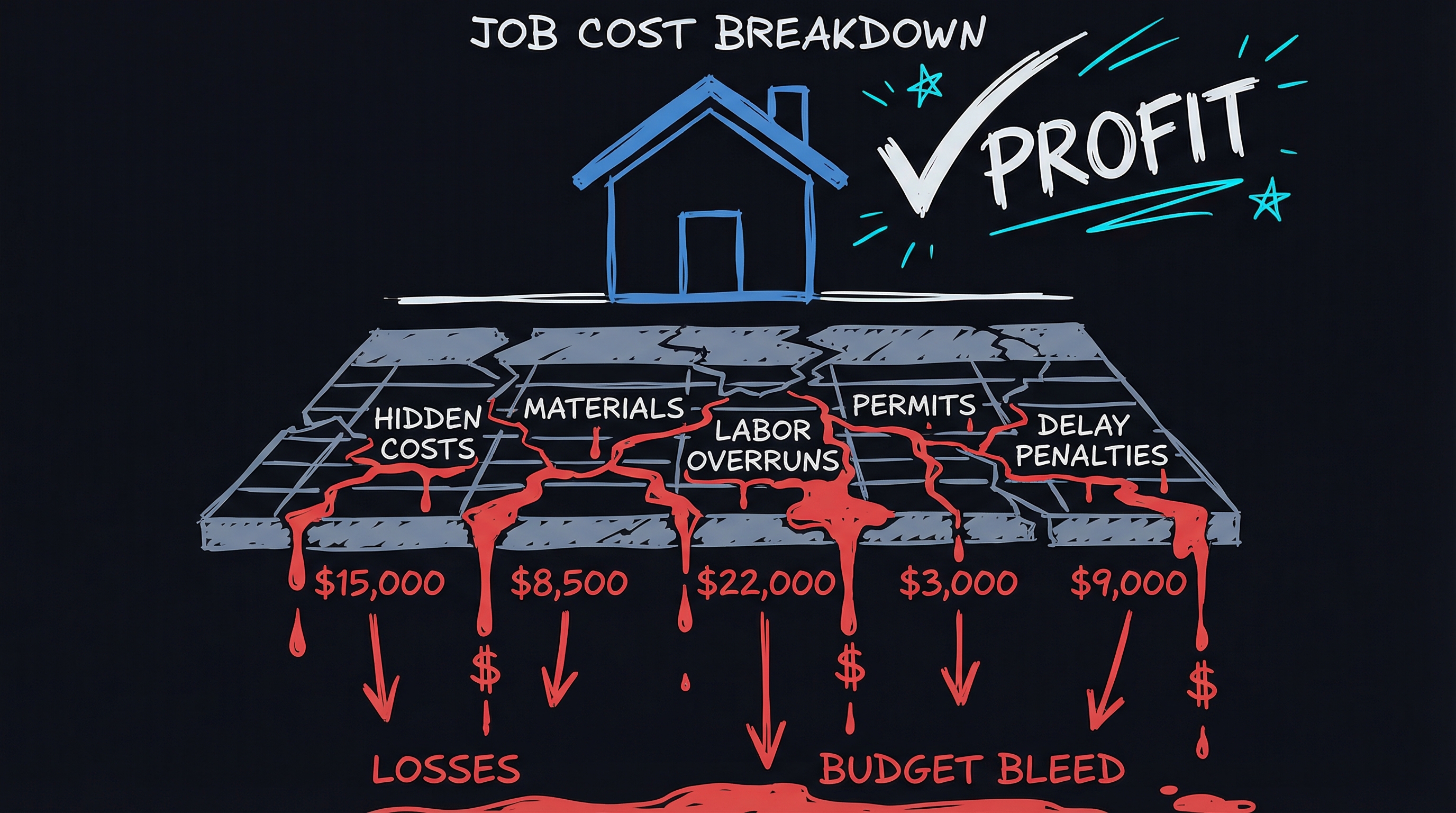
Material costs ran higher than estimated. Your lead guy put in 15 hours of overtime you didn’t catch. The debris dump charged you twice. That emergency supply run on Saturday cost premium pricing. None of it showed up until the final accounting.
Why Job Costing Fails
Most contractors track expenses the same way: receipts in the truck, enter them “when there’s time,” reconcile everything after the job wraps.
By the time you know the numbers, it’s too late to do anything about them.
Week 1: Materials look good. Under budget. Crew’s efficient.
Week 2: A few extra supply runs. No big deal, right?
Week 3: Overtime starts stacking up. You figure you’ll make it up on the next job.
Final Accounting: You’re $12K in the hole and have no idea where it went wrong.
You’re not bad at estimating. You’re flying blind until the damage is done.
What This Costs
Typical small roofing company, 40 jobs per year:
- 30% of jobs run over budget by $3,500 average (conservative)
- 12 jobs × $3,500 = $42,000 in lost profit annually
- All because you found out too late
Without real-time tracking, you can’t catch cost overruns while there’s time to adjust. You repeat unprofitable job types because you don’t know which ones bleed money. Your cash flow gets hammered when “profitable” jobs turn out to be losers.
One contractor bid three identical $45K jobs. Two months later: one made $8K, one made $2K, one lost $4K. Same job, wildly different outcomes. He had no idea which was which until it was too late.
How Real-Time Tracking Works
Smart contractors track expenses as they happen:
- Material purchases logged immediately (photo of receipt, auto-categorized)
- Hours worked hit the system in real-time (timesheet integration)
- Every expense compares automatically against estimate (see variance the day it happens)
Week 1: Materials 8% over estimate. Switch suppliers for remaining materials. Saved $2,400.
Week 2: Overtime alerts trigger. Shift crew scheduling before it compounds. Saved $1,800.
Week 3: Still profitable because you caught problems when they were fixable.
The Automation Version
Automated job costing runs in the background:
- Crew texts receipt photo → Auto-categorized → Compared to estimate → Alert if over
- Hours worked → Auto-calculated against labor estimate → Daily variance report
- All expenses → Real-time profitability dashboard → Know exactly where you stand
The contractors using this aren’t smarter. They just know on Tuesday that Wednesday’s material order will push them over budget, so they adjust. The manual guys find out 60 days later when there’s nothing left to adjust.
Your Options
Starter ($5K-$15K): Job tracking with expense alerts and budget comparison.
Growth ($15K-$30K): Multi-job tracking, timesheet integration, variance reports.
Enterprise ($30K-$50K): Complete visibility across crews and locations.
One-time investment, 25% annual maintenance. You own it. Break-even in 14-18 months.
Book a 60-Minute Strategy Session ($150, credited toward implementation). We’ll map your job costing process, identify where you’re losing visibility, and create your automation roadmap.
Two Paths
Keep guessing - Hope your estimates are right, find out 60 days later if you made money.
Start knowing - See real-time where every dollar goes, catch overruns while they’re fixable.
The contractors who waited? Still celebrating “profitable” jobs that lost money. The ones who automated? They stopped celebrating early and started knowing the actual numbers.
P.S. That $85K job that lost $12K? With real-time tracking, you’d have caught the overruns in week 2. The job would have made $6K instead of losing $12K. That’s an $18K swing on one job. Multiply that across 40 jobs per year.
AIL-3 | AI Transparency: This article was drafted with AI assistance and reviewed, edited, and approved by the author. All recommendations are based on 20 years of experience in the roofing and construction industry.