Table of Contents
Stop Entering the Same Customer Info 6 Times (And Start Getting Your Life Back)
How small contractors are eliminating data entry and saving 10-20 hours per week
The 3:47 PM Frustration Every Contractor Knows
It’s late afternoon and you’re finally sitting down to create the invoice for the Peterson roof job. You pull up your invoicing software and start typing:
“John Peterson, 1247 Oak Street, Denver, CO 80221…”
Wait. Didn’t you already enter this exact same information when you:
- Put the lead in your CRM?
- Created the initial quote?
- Filled out the permit application?
- Ordered materials from your supplier?
- Sent the work order to your crew?
Six times. The same customer information. Typed over and over again.
And this is just ONE job. Multiply that by every customer, every week, every month…
The Hidden Cost of “Just Getting It Done”
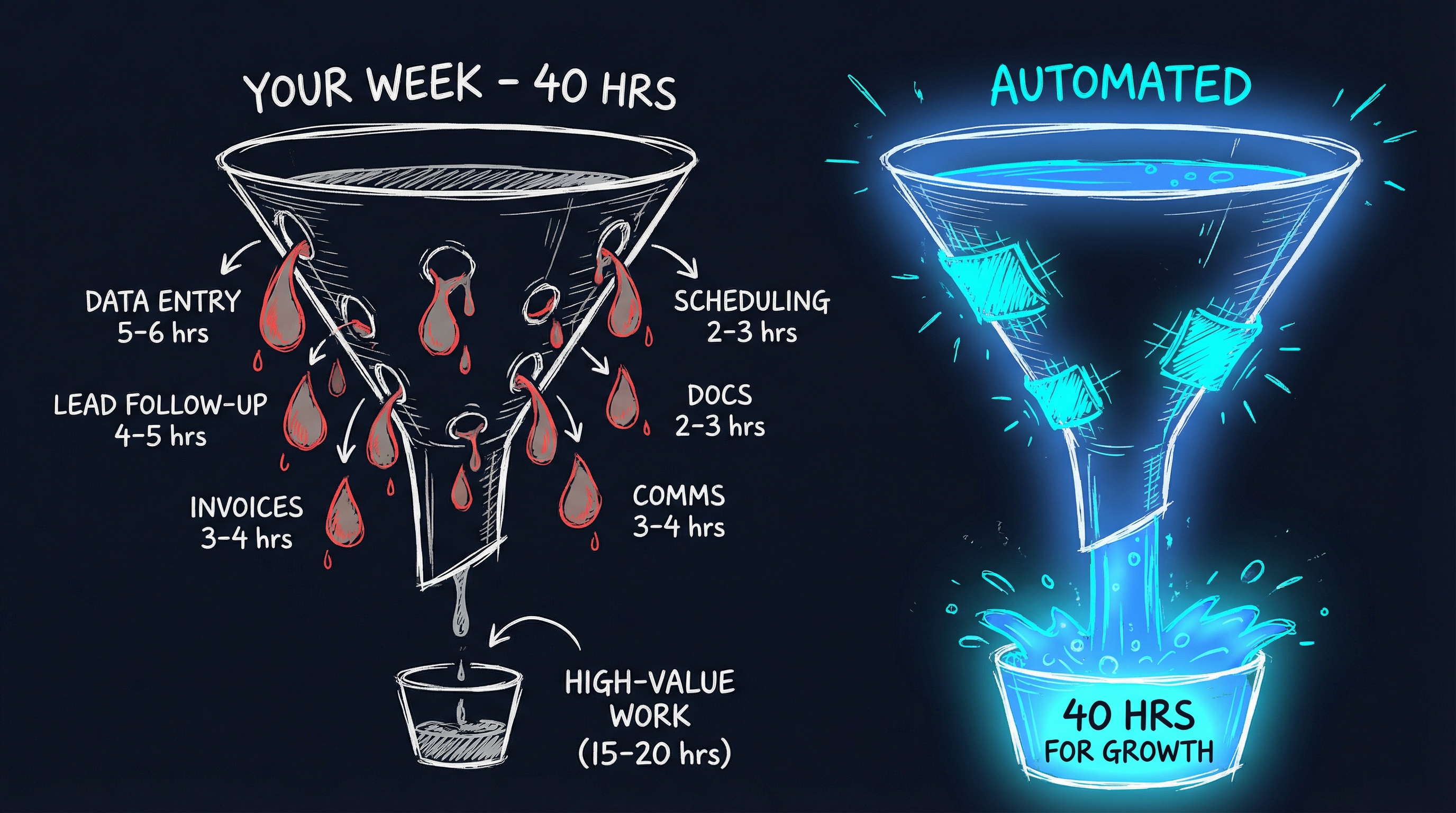
Here’s what most small contractors don’t realize: You’re paying someone $25-30 per hour to be a human copy machine.
Think about your typical week:
- 10 new leads come in (20 minutes of data entry each)
- 8 quotes need to be created (15 minutes each)
- 6 jobs move to permits/material orders (10 minutes each)
- 12 invoices need to be sent (8 minutes each)
- Follow-ups, scheduling changes, customer updates…
That’s 10-15 hours per week just moving the same information from one place to another.
At $27/hour, you’re spending $1,400+ per month on pure data shuffling. That’s $16,800 per year per person doing administrative work.
But if you’re doing this work yourself as the business owner, multiply those numbers by 4-10x, because your time is worth more—probably closer to $100 to $300+ per hour. Your time should be spent on high-value activities that grow your company, not copying customer addresses from one system to another.
And that’s if nothing goes wrong. What about when:
- Someone types the address incorrectly and materials get delivered to the wrong house
- A phone number gets transposed and you can’t reach the customer
- Project details get lost between the quote and the work order
- Insurance information doesn’t match between systems
Why Smart Contractors Are Done With Data Entry
While you’re typing the same information for the sixth time, some contractors have figured out a better way.
Imagine this scenario: A homeowner calls about a roof replacement. Your phone system captures their information automatically. By the time you hang up, their details are already in your CRM, a quote template is populated with their information, and you’re ready to schedule an estimate appointment.
No typing. No copying and pasting. No switching between 5 different software programs.
Or this one: You get an email inquiry through your website. The system automatically extracts the customer details, creates a new project in your CRM, sends them a professional follow-up email, and adds a task to your calendar to call them within 24 hours.
While your competitors are still manually entering lead information, you’re already scheduling the appointment.
The Real-World Impact
I came from the construction industry myself. I remember the paper files, the fax machines, and yes—typing the same customer information into multiple systems every single day.
When I started automating my own processes, the difference was immediate:
- Data entry time: From 2+ hours daily to about 15 minutes
- Errors from retyping: Virtually eliminated
- Time to respond to leads: From hours to minutes
- Administrative stress: Dramatically reduced
Now I help other contractors implement these same systems. The math is simple but powerful:
If automation saves you just 10 hours per week at $27/hour, that’s $270 weekly. Over a year, that’s $14,040 in time savings. If you’re the owner doing this work at $150/hour, that’s $78,000 annually.
The investment varies depending on your business size and automation scope. Our Starter Package ($5,000-$15,000) handles essential automations for smaller teams, while our Growth Package ($15,000-$30,000) includes comprehensive workflow integration for expanding companies. Unlike software you rent forever, you own your automation system. Even conservative time savings typically provide strong returns within the first year.
What’s Actually Possible Today
This isn’t future technology. Small contractors are implementing these systems right now:
Automatic Lead Capture: Phone calls and web inquiries flow directly into your CRM with zero manual entry.
One-Time Data Entry: Customer information enters your system once and populates everywhere it’s needed—quotes, permits, material orders, invoices, work orders.
Intelligent File Organization: Documents automatically get named, categorized, and filed in the right project folders.
Automated Follow-ups: Email sequences that nurture leads, follow up on quotes, and send payment reminders without you lifting a finger.
Smart Scheduling: Systems that coordinate customer availability, crew schedules, and material deliveries automatically.
The companies investing in automation aren’t just saving time—they’re providing faster, more professional service than competitors who are still stuck in manual mode.
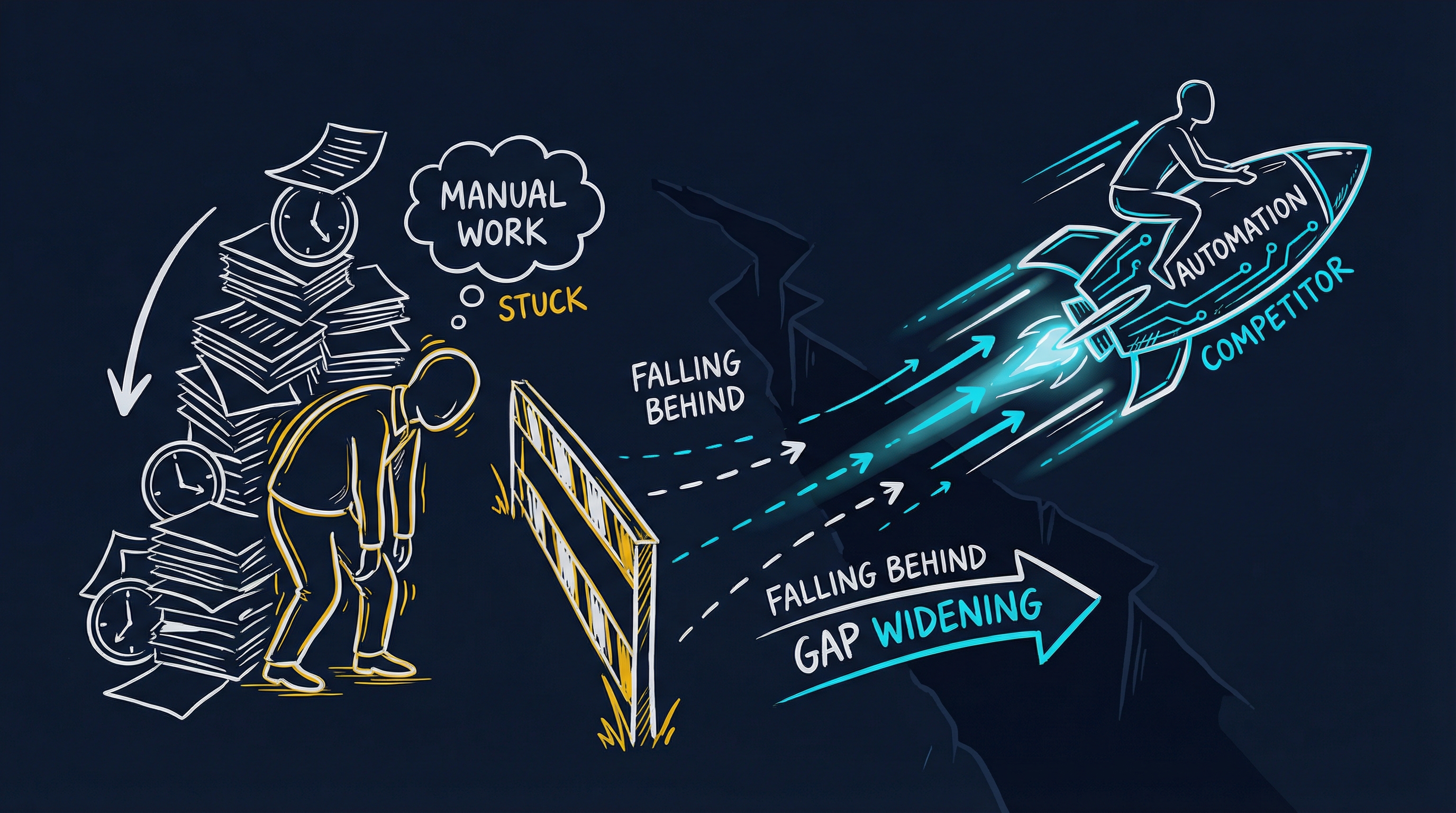
The Two Types of Contractors
Type 1: Still juggling paper files AND digital systems “just in case.” Entering the same information multiple times across different platforms. Spending 30-40% of their time on administrative tasks that could be automated.
Type 2: Built streamlined systems where information flows automatically from lead capture to project completion. Spending their time growing the business instead of managing paperwork.
The gap between these two is getting wider every month.
Your Next Step
If you’ve read this far, you’re clearly thinking about working smarter, not harder. You understand that your time is worth more than $27/hour spent on data entry.
The question is: What would you do with an extra 10-15 hours per week?
More estimates? Better customer service? Actually taking a weekend off?
Ready to eliminate 20+ hours of weekly busywork? Book a 60-minute Construction Automation Strategy Session ($150, credited toward implementation) where we’ll:
- Identify your biggest time-wasters and inefficiencies
- Design a custom automation roadmap for your specific workflow
- Calculate your exact ROI and implementation timeline
- Give you a clear picture of what’s possible for your business
This is a premium consultation where you get actionable strategies whether you move forward or not.
CLICK HERE TO SCHEDULE YOUR STRATEGY SESSION
The Bottom Line
Every minute you spend entering the same customer information multiple times is a minute you’re not growing your business, serving customers better, or enjoying the life you built this company to create.
The technology to eliminate this frustration exists today. Small contractors are using it right now to save thousands of dollars and dozens of hours every month.
The question isn’t whether automation works for construction companies. It’s whether you’re ready to stop being a human copy machine and start running a truly efficient business.
Frequently Asked Questions
How much time does duplicate data entry actually waste?
For most small contractors, duplicate data entry across CRM, accounting, estimating, and project management software costs 8-15 hours weekly. At $75-100/hour for an owner’s time, that’s $62,400-$78,000 annually spent on redundant typing. Even worse, each re-entry introduces error risks that can cost thousands in billing mistakes.
Can automation integrate with the software we already use?
Yes - modern automation platforms can connect virtually any construction software through APIs or integrations. Whether you’re using QuickBooks, Xactimate, BuilderTREND, or custom spreadsheets, automation can sync data between systems automatically. You keep the tools you know while eliminating the redundant work.
What happens if the automation breaks or data gets corrupted?
Professional automation includes error handling, data validation, and backup protocols. Systems monitor for integration failures and alert you immediately. Most importantly, you maintain full access to your original systems - automation enhances your workflow but doesn’t replace manual access when needed.
How quickly can we implement data integration automation?
Basic integration (2-3 systems) typically takes 7-10 days for setup and testing. Comprehensive integration across all your construction software usually requires 2-3 weeks. You’ll see immediate time savings - most contractors report reclaiming 10+ hours in the first week alone.
Will this work with our construction-specific software like Xactimate?
Absolutely - construction automation is designed specifically for tools like Xactimate, CompanyCam, Buildertrend, and industry-specific platforms. These aren’t generic business integrations - they understand construction workflows, from estimate creation through final invoice and everything in between.
P.S. - Even if you only eliminate 5 hours of data entry per week, that’s $7,020 in annual time savings. Our automation packages typically pay for themselves in 4-6 months through time savings alone. One-time investment, lifetime value: You own your automation system, we provide the service experience. Unlike subscription software that costs thousands annually forever, your system breaks even in 4-6 months, then you keep the savings permanently. The real question is: what’s the cost of NOT automating?
AIL-3 | AI Transparency: This article was drafted with AI assistance and reviewed, edited, and approved by the author. All recommendations are based on 20 years of experience in the roofing and construction industry.