Table of Contents
How Top Contractors Eliminated “New Employee Training Nightmares” (And Built Better Teams in the Process)
Why automated systems let you hire the eager 25-year-old over the jaded “experienced” candidate—and crush the competition doing it
The Tuesday Morning Interview
You’re sitting across from two candidates for your new office coordinator position.
Candidate A: 15 years of construction office experience. Knows QuickBooks inside and out. Has “always done it this way” written all over her resume. Wants $65,000 and makes it clear she’s doing you a favor by applying.
Candidate B: 25 years old, eager as hell, asks great questions about your business vision. Has never worked construction but handled customer service at a busy restaurant. Willing to start at $42,000 and genuinely excited about the opportunity.
Ten years ago, you hired Candidate A every time. You needed someone who already knew the systems, could handle the chaos, and wouldn’t need months of hand-holding.
Today, smart contractors are hiring Candidate B—and it’s not even close.
The Experience Trap Nobody Talks About
Here’s the dirty secret about hiring “experienced” people in construction:
60-70% of their onboarding time isn’t teaching them construction knowledge—it’s teaching them YOUR specific manual processes.
Think about what you’re really training them on:
- How to manually enter the same data into QuickBooks, your project management spreadsheet, and your CRM
- Your specific format for creating estimates in Excel (with those formulas that break if you look at them wrong)
- The “system” for tracking which invoices are 30, 60, 90 days past due
- How to remember to follow up on estimates that haven’t closed
- The process for scheduling appointments without double-booking
- Your particular method for organizing project documents
None of this is construction knowledge. It’s all manual process memorization.
And the “experienced” hire? They’re fighting you every step of the way because “that’s not how we did it at my last company.”
What Automated Systems Actually Change
When your business runs on automated workflows instead of manual processes, something fundamental shifts:
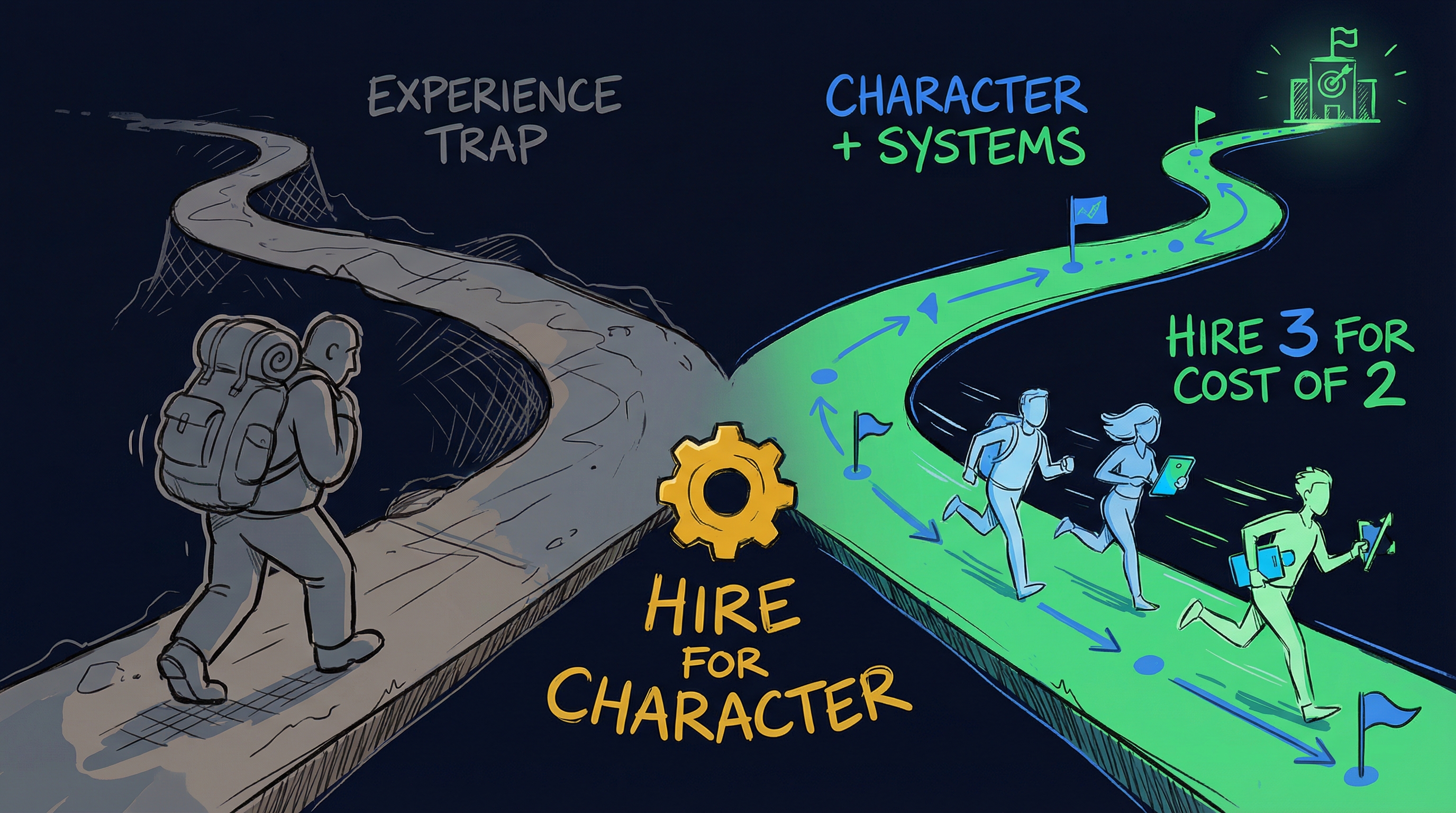
Character becomes more valuable than credentials.
Here’s why:
The Automation Training Reality
With automated systems in place:
- New hire learns the automation interface (2-4 weeks) instead of legacy manual processes (3-6 months)
- Systems handle data entry, follow-ups, scheduling—you’re teaching business judgment, not Excel formulas
- Mistakes get caught by automation instead of creating disasters
- Good attitude + coachable spirit > years of “experience” doing it the old way
Real example: One of my roofing contractor clients hired a 23-year-old with zero construction experience but incredible work ethic. With their automated quoting and scheduling system, she was fully productive in 18 days. Their previous “experienced” hire took 4 months to get up to speed and quit after 7 months because she hated the new systems.
The Character-Based Hiring Advantage
When automation handles the repetitive manual work, you can hire for what actually matters:
What Character Gets You (That Experience Doesn’t):
Hungry vs. Entitled:
- Character hire: “How can I help the business grow?”
- Experience hire: “This isn’t in my job description”
Adaptable vs. Resistant:
- Character hire: “Show me how the system works, I’ll master it”
- Experience hire: “Why don’t we just do it the way I’m used to?”
Loyal vs. Transactional:
- Character hire: “You gave me a shot, I’m grateful”
- Experience hire: “I’ve got 15 years experience, you’re lucky to have me”
Growth-Minded vs. Fixed:
- Character hire: “Can I learn that process too?”
- Experience hire: “That’s not what I was hired to do”
Lower Salary Expectations:
- Character hire: $38K-$48K with room to grow
- Experience hire: $60K-$75K and resistant to automation that “threatens” their expertise
The Competitive Moat You’re Building
Here’s what most contractors miss: When you build a business that runs on automated systems instead of manual expertise, you create a talent advantage your competitors can’t match.
Why This Becomes Your Competitive Moat:
1. Scalable Team Growth
- You can hire 3 solid character-based employees for the cost of 2 “experienced” ones
- Training time drops from 3-6 months to 2-4 weeks
- You can scale your team 40-60% faster when good systems do the heavy lifting
2. Culture Control
- You build the team culture YOU want instead of inheriting attitudes from previous employers
- Hire people who fit your vision instead of settling for whoever knows your legacy systems
- Create loyalty through opportunity instead of dependence on their “expertise”
3. Lower Turnover
- Character-based hires stay longer (grateful for the opportunity)
- Automation eliminates the “this isn’t what I signed up for” friction
- Good people with good systems beat jaded veterans with spreadsheets
4. Performance Ceiling
- Eager 25-year-old + automation outperforms 45-year-old veteran + manual processes
- Fresh perspective often spots inefficiencies veterans are blind to
- Willingness to learn beats “I know better” every single time
Real-World Transformation: The HVAC Company That Flipped Their Hiring
I worked with a commercial HVAC company (22 employees) that was stuck in the experience trap.
Their Old Reality:
- Paying $70K for “experienced” office managers who resisted every change
- 4-6 month onboarding process teaching manual systems
- High turnover (18-24 months average tenure)
- Attitude problems from people who felt irreplaceable
After Implementing Enterprise Automation:
They hired a 26-year-old with hospitality management experience at $45K. She:
- Mastered the automated quoting system in 12 days
- Was fully productive in 3 weeks
- Suggested process improvements by week 6 (things the “experienced” hires never questioned)
- Became their best office coordinator within 6 months
- Still with them 3 years later, now managing two other coordinators
The owner’s quote: “We were hiring for the wrong thing. We needed someone smart and eager who could learn our systems. Automation made the systems learnable in weeks instead of months. Best hire we ever made.”
What This Looks Like In Practice
Scenario 1: Customer Service Role
Old Way (Manual Processes):
- Need: Someone who knows construction, QuickBooks, has handled difficult customers
- Reality: Paying premium for jaded attitude and resistance to change
- Training: 3-4 months to learn all your specific manual processes
- Result: Decent performance, zero innovation, leaves when competitor offers $3K more
New Way (Automated Systems):
- Need: Someone with great communication skills, problem-solving ability, positive attitude
- Reality: Eager person who sees this as opportunity, not just another job
- Training: 2-3 weeks to learn automated systems and business context
- Result: High performance, brings fresh ideas, builds loyalty through growth
Scenario 2: Project Coordinator Role
Old Way (Manual Processes):
- Need: Must have construction PM experience, know scheduling software, understand trades
- Reality: Limited candidate pool, high salary demands, “I’ve seen it all” attitude
- Training: 4-6 months learning your specific manual tracking methods
- Result: Gets job done but resists improvements, expensive to replace
New Way (Automated Systems):
- Need: Organized, detail-oriented, good with people, coachable
- Reality: Large candidate pool, reasonable salary expectations, genuine enthusiasm
- Training: 3-4 weeks learning automated workflow systems
- Result: Fast ramp-up, embraces system improvements, grows with company
The Two Types of Construction Companies Emerging
Type 1: Manual Process Dependent
- Forced to hire “experienced” people who know the old ways
- Stuck paying premium salaries for resistant attitudes
- Long training timelines limit growth speed
- High turnover when better offers come along
- Settling for whoever applies instead of building dream team
Type 2: Systems-Powered (Automation-Based)
- Free to hire for character, attitude, and cultural fit
- Paying for potential and work ethic, not just credentials
- Fast onboarding enables rapid team scaling
- Loyalty built through opportunity and growth
- Building dream team because systems are learnable
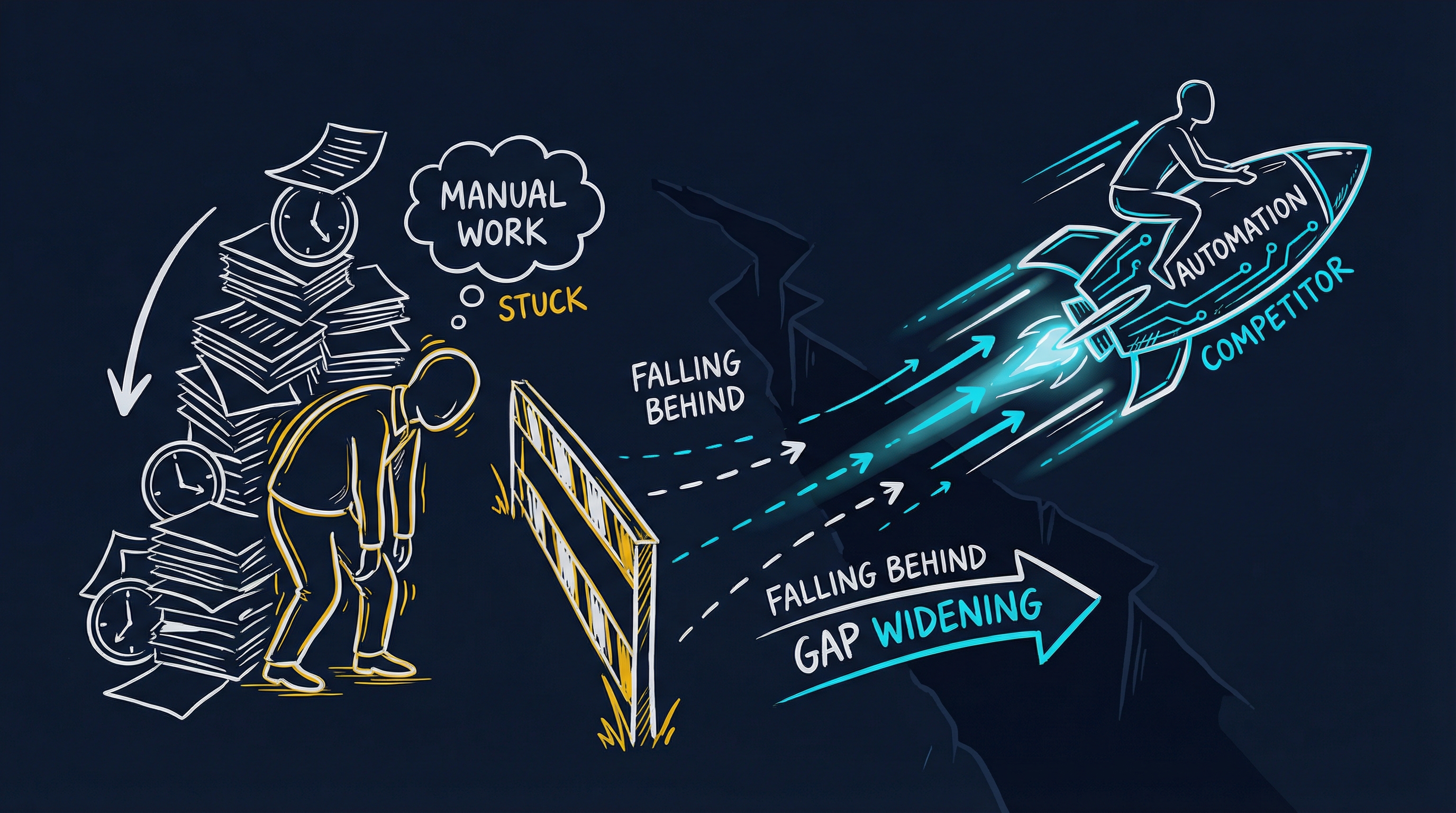
The gap between these two types gets wider every month.
What the Enterprise Package Actually Delivers
The contractors making this shift aren’t running basic automation. They’re building complete systems that make character more valuable than experience:
Scalable Training Systems:
- Automated onboarding workflows that teach themselves
- Video training libraries for every process
- System documentation that updates itself
- Built-in quality controls that catch mistakes
Standardized Operations:
- Workflows that run the same way every time
- Clear processes that anyone can follow
- Automated quality checks preventing disasters
- Systems that scale without adding complexity
Growth Infrastructure:
- Can double team size without doubling training time
- New hires productive in weeks, not months
- Culture stays consistent as team grows
- Systems enable growth instead of limiting it
Implementation Range: $30,000-$50,000 for companies with 15-50 employees Payback Period: 8-18 months through combination of labor savings and revenue growth ROI: 300-500% within first year through faster scaling and better talent leverage
Frequently Asked Questions
Won’t hiring inexperienced people create more problems than it solves?
Not when systems handle the complexity. Automation eliminates most “experience-based” tasks (data entry, process memory, manual tracking). You’re teaching business judgment and customer service—which character-based hires often excel at. The HVAC company example above shows this clearly: their best coordinator ever had zero construction experience before joining.
How long does it really take to train someone on automated systems vs. manual processes?
Manual process training: 3-6 months for full productivity (60-70% of time teaching YOUR specific manual methods). Automated system training: 2-4 weeks for full productivity (teaching interface and business context). The difference is whether you’re teaching memorization or understanding. Systems documentation teaches itself; manual processes require shadowing and repetition.
What if we’re not big enough for Enterprise-level automation?
Character-based hiring works at any scale with automation. Growth Package ($15K-$30K for 5-15 employees) delivers the same principle—standardized systems anyone can learn quickly. Even Starter Package ($5K-$15K) eliminates enough manual work to make training faster. The scale matters less than the shift from manual processes to systematic workflows.
Can this really create a “competitive moat” in hiring?
Absolutely. While competitors fight over the limited pool of “experienced” candidates, you’re hiring from the much larger pool of smart, hungry people with great attitudes. You can hire faster, pay less, and build better culture. Within 18-24 months, you’ll have a team your competitors can’t replicate because they’re still dependent on manual expertise you’ve eliminated.
What happens when the eager new hire wants more money after becoming valuable?
Give it to them! That’s the beauty of this model—you started at $42K instead of $65K. You can give meaningful raises ($48K, $55K, $62K over 3 years) and still come out ahead while building insane loyalty. Compare that to the “experienced” hire starting at $70K who expects $75K after a year. Plus, character-based hires tend to value growth opportunity and culture fit as much as pure salary.
Finding the Right Automation for Your Team
Every construction business has unique team dynamics and growth challenges. What works for a 5-person residential remodeling company looks different from a 30-person commercial contractor.
The first step is understanding exactly where automation can transform your hiring and training—creating systems that make character more valuable than credentials in your specific business.
If you’re ready to build a team based on who people are instead of settling for who knows your legacy systems, I offer a 60-minute Construction Automation Strategy Session ($150, credited toward implementation if you proceed).
We’ll map out your current hiring challenges, identify where automation eliminates the “experience requirement,” and create a specific roadmap for building the team you actually want—not the team you’re forced to settle for.
During this session, we’ll analyze:
- Which roles currently require “experience” only because of manual processes
- How automation changes your hiring criteria and talent pool
- Expected training timeline reduction and cost savings
- Team scaling roadmap enabled by systematic workflows
- Character-based hiring strategy for your market and culture
The Team You Actually Want
Think about this: What if you could hire people who are excited to work for you, grateful for the opportunity, and eager to grow—instead of settling for whoever already knows your outdated manual processes?
What if you could build a team based on attitude, work ethic, and cultural fit—instead of being held hostage by “experienced” people who resist every improvement?
What if the best hire you ever made was someone your competitors would have passed over for “lack of experience”?
That’s not a fantasy. That’s what systematic automation enables.
The contractors who build these systems now are creating talent advantages their manual competitors can’t match. They’re hiring faster, training quicker, paying less, building better culture, and scaling without the traditional limitations.
The gap gets wider every quarter.
Which team are you building?
P.S. The ownership model matters here too: When you own your automation systems instead of renting software forever, you can afford to invest in great people. One-time investment ($30K-$50K) creates systems that make every future hire easier and cheaper. Break-even in 14-18 months, then you’re scaling with better talent at lower cost. That’s a competitive moat your subscription-trapped competitors can’t build.
AIL-3 | AI Transparency: This article was drafted with AI assistance and reviewed, edited, and approved by the author. All recommendations are based on 20 years of experience in the roofing and construction industry.