Table of Contents
How Smart Contractors Stopped Eating Insurance Shortfalls
The supplement management system that closes the gap between what adjusters pay and what the work actually costs.
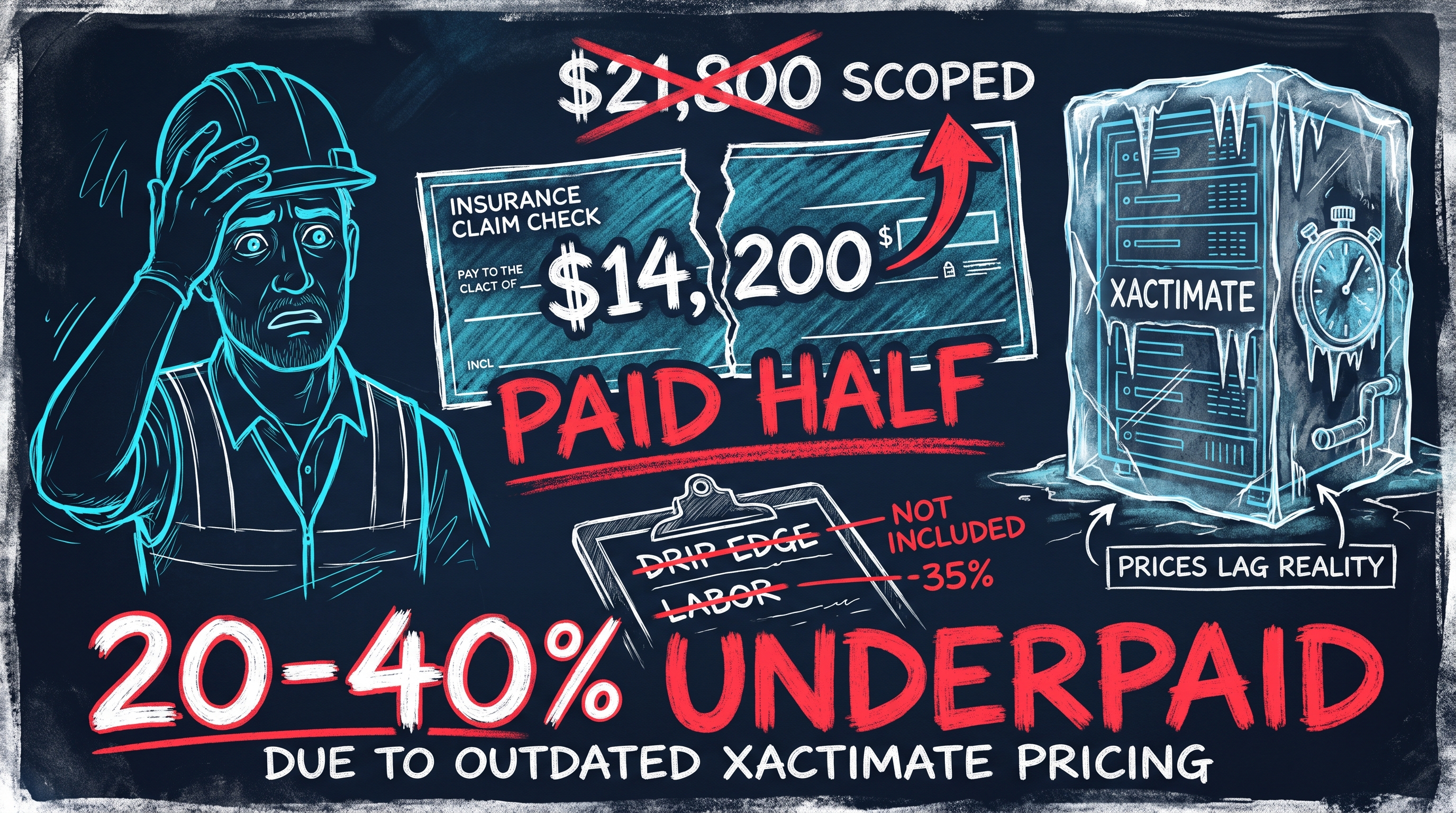
Previously: They Didn’t Deny Your Claim. They Just Paid You Half of What It Costs. - Why insurance underpayment is a 20-40% problem most contractors never fight.
How Documentation Changes the Math
Here’s what’s different about underpayment versus denial: you can pre-empt a lot of it.
Denial happens after you submit. Underpayment happens during the scope and estimate process — and that’s a fight you can win if you arrive with documentation the adjuster can’t just override.
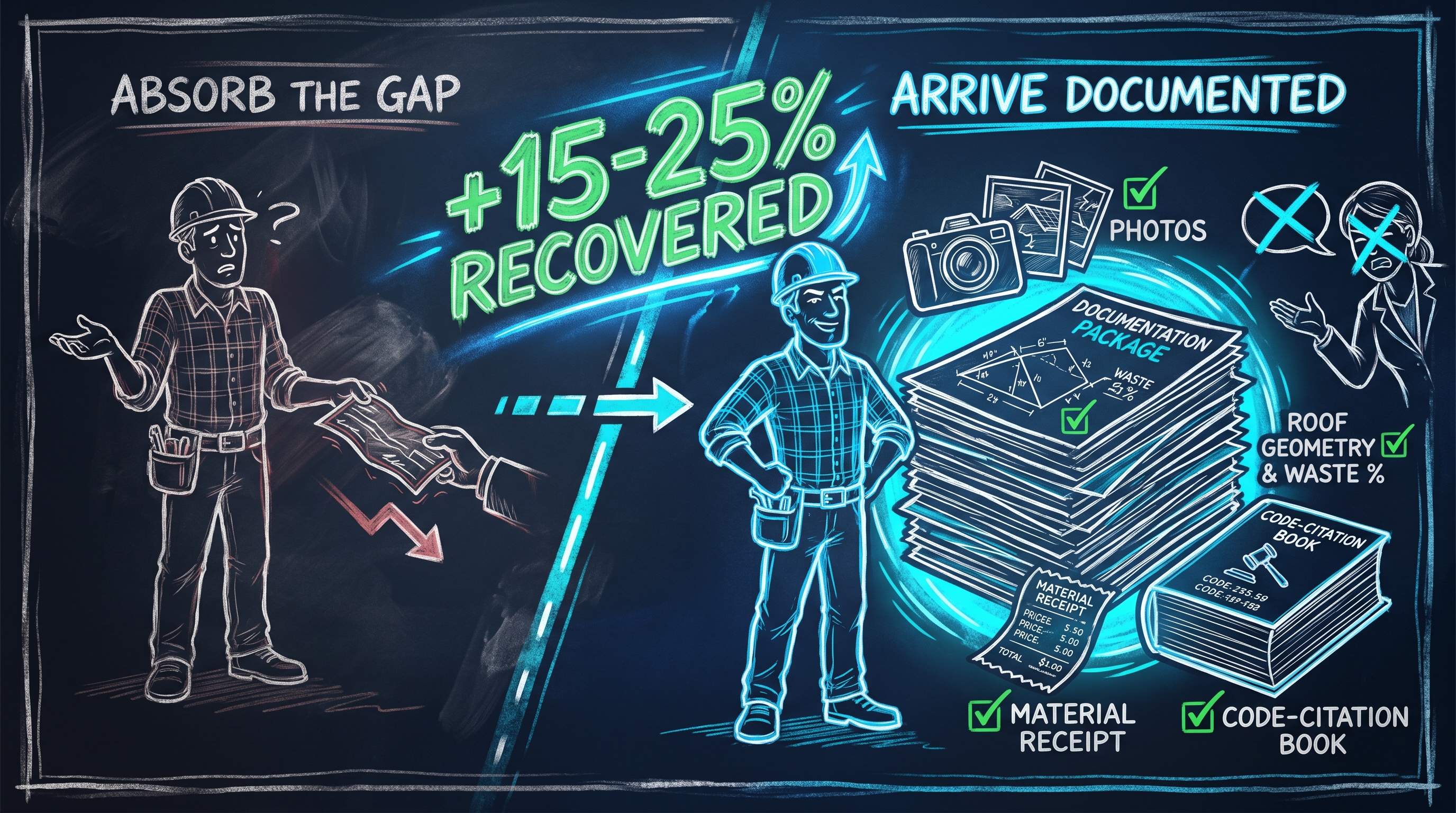
Before: Receive adjuster’s estimate → price job at their numbers → do the work → absorb the gap
After: Arrive with your documentation package → geometry-backed waste calculations → photos of every line item → current material receipts → adjuster can’t dispute what’s already documented
Contractors who document this way consistently recover 15-25% more on the same jobs compared to contractors using standard documentation practices.
What the Documentation Package Looks Like
The adjuster can’t look at your photos and tell you drip edge isn’t part of the scope. He can’t argue your waste calculation when you have the geometry diagrammed. He can’t apply depreciation to code-required upgrades when you have the code citation in writing.
The package that makes that happen:
Measurements that match reality. Not estimates. Actual geometry with the calculations to support your waste factor on a hip roof with dormers.
Photos of every line item. Timestamped, geotagged, organized so there’s no ambiguity about what was damaged and what was required to fix it.
Manufacturer installation specifications. Confirms what’s required — not what the adjuster thinks is optional.
Local building codes documented. For the specific materials being applied, in your jurisdiction. Takes depreciation on code-required items off the table.
Current material receipts. Actual cost, not Xactimate’s lagged database prices. Hard to argue against what you actually paid.
Supplement Management Is a Business Function
The mindset shift that separates contractors who get paid properly: supplementing a claim isn’t adversarial. It’s a normal part of the job.
Every insurance claim has a first estimate and a final estimate. The gap between them is where your money lives. Supplements cover material cost increases from initial scope to when you’re actually buying. They cover missed line items — and there are always missed line items. They cover code upgrades the adjuster didn’t account for.
A proper supplement workflow tracks every variance between your scope and the adjuster’s scope from the moment you receive their estimate. It generates the documentation package. It follows the timeline on carrier response requirements. It escalates to the public adjuster or attorney channel when the carrier stonewalls.
Not on big jobs when you have time. On every job, automatically, because the process runs whether you’re thinking about it or not.
The Competitive Edge
Contractors who treat supplementing as routine — with a documented workflow for tracking every missed item, every price discrepancy, every code requirement — recover that money systematically. Contractors who treat it as an occasional battle when the shortfall is too big to ignore are leaving the majority of it behind.
At $1.5 million in annual insurance work, recovering an additional 15% is $225,000 per year. That’s not found money. That’s money you already earned that the carrier was counting on you not claiming.
What It Takes
Implementation: $15,000-$25,000 depending on current workflow complexity Timeline: 3-4 weeks to full deployment Break-even: 1-2 jobs Annual recovery: $150,000-$400,000+ depending on volume
One-time investment. You own the system — no monthly fees, no software subscriptions.
Your Next Step
Book a 60-Minute Strategy Session →
We’ll map your current claims workflow, pull your last 10-15 jobs, and calculate what systematic supplement management would have recovered. Most contractors are surprised by the number. $150, credited toward implementation if you move forward.
FAQ
Won’t carriers just push back harder if I supplement everything?
Carriers push back on unsupported supplements. They have a much harder time disputing supplements backed by photographs, geometry, manufacturer specs, and current receipts. The documentation is what makes the difference — it’s not aggression, it’s evidence.
How long does this take to set up when I’m already running full crews?
Three to four weeks from kickoff to a running system, and most of that time doesn’t require your involvement. We build the workflow around how your crews already capture information on-site. You’re not adding steps — you’re automating the steps you’re already taking inconsistently.
One-time investment, lifetime value. Most contractors recover the full implementation cost within the first two or three supplemented claims.
AIL-3 | AI Transparency: This article was drafted with AI assistance and reviewed, edited, and approved by the author. All recommendations are based on 20 years of experience in the roofing and construction industry.