Table of Contents
3 in 5 Contractors Struggle With Customers Calling Asking for Project Updates - Here’s Why
The $47,000 annual cost of “just checking in” phone calls (and the automated system that eliminates them)
The Tuesday Morning Interruption
It’s 10:15 AM on Tuesday and you’re finally making progress on the Henderson job site. Your lead installer just figured out the fix for that tricky flashing detail, and you’re walking him through the next steps.
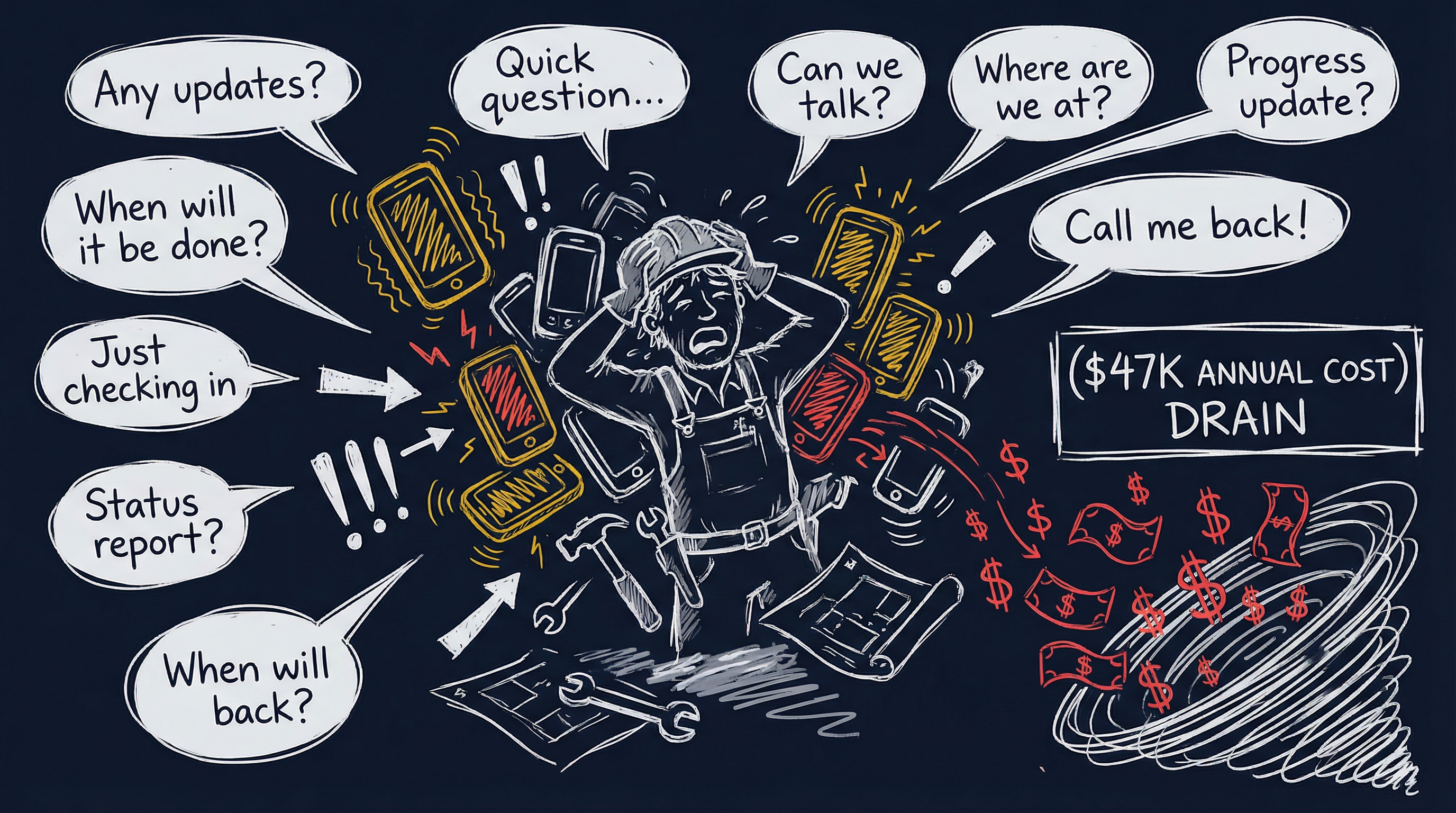
Then your phone rings. It’s Mrs. Patterson from the Watson Street project wanting to know if you’re still on schedule for Thursday’s inspection.
You step away from your crew, spend 8 minutes reassuring her that everything’s on track, promise to send photos later today, then try to get back into the flow of what you were doing.
Before lunch, you’ll get three more calls just like it. By Friday, you’ll have fielded 23 “just checking in” calls from customers who simply want to know what’s happening with their projects.
And every single one of those calls is costing you money.
The Hidden Cost of “Good Customer Service”
Here’s what most contractors miss: Those “quick update calls” are destroying 12-18 hours of productive time every single week.
Think about it:
- Average call duration: 6-8 minutes (including time to stop what you’re doing, take the call, and get back on task)
- Frequency: 3-5 calls per active project per week
- Recovery time: 5-10 minutes to regain focus after each interruption
- Total weekly cost: 12-18 hours of fragmented, unproductive time
If your time is worth $150/hour (and it should be), those “just checking in” calls are costing you $93,600 to $140,400 annually.
But the cost goes deeper than just time.
The Domino Effect Nobody Calculates
When you’re constantly interrupted by update calls, three expensive problems compound:
Problem 1: Your Crew Works Without Direction
Every time you step away to take a “quick call,” your team loses momentum. They wait for answers, make assumptions, or work on less critical tasks. A job that should take 3 days stretches to 4.5 days because of constant interruptions.
Cost: 15-20% longer project timelines
Problem 2: You Appear Disorganized (Even When You’re Not)
When customers have to call for updates, they’re really saying: “I don’t feel confident you’re on top of this project.” It doesn’t matter that you’re managing everything perfectly—if they don’t see it, they don’t believe it.
Cost: Fewer referrals, more price shopping on future projects
Problem 3: The Wrong Work Gets Your Attention
The most demanding customers get the most updates. The quiet, easy customers (who actually deserve your time) get overlooked. You’re rewarding the squeaky wheels while neglecting your best clients.
Cost: Losing your ideal customers to competitors who communicate proactively
What Automated Contractors Do Differently
Here’s what changed everything for me (and the contractors I work with now):
Manual Reality (What You’re Doing Now):
- Customer wonders about project status → Calls you → You stop working → Answer same questions you answered yesterday → Promise to send photos “later” → Forget because you’re busy → Customer calls again tomorrow
Automated Reality (What’s Possible):
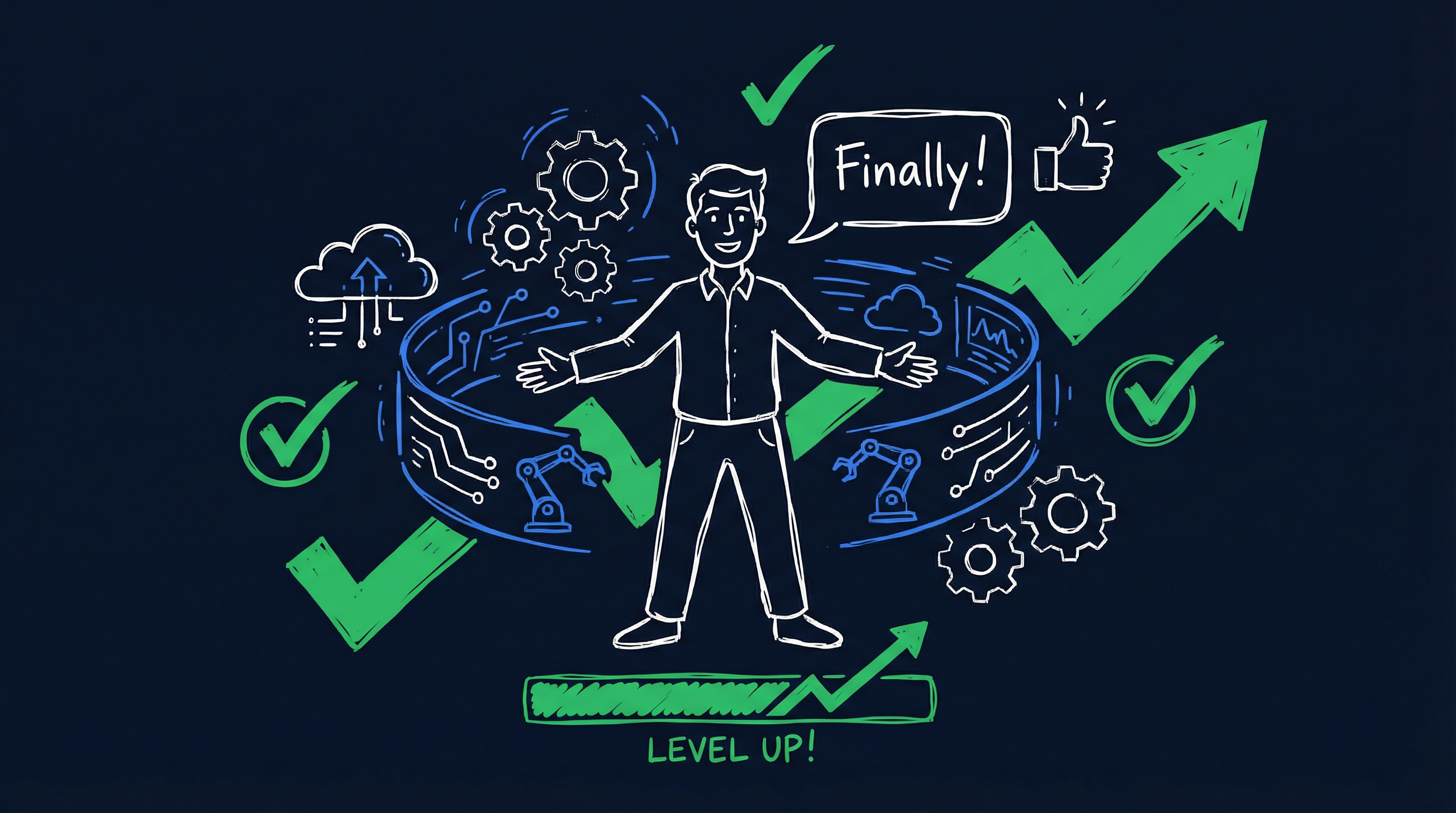
- Project milestone reached → System sends automatic update with photos → Customer receives detailed status before they even think to ask → They feel informed and confident → You never get interrupted
The difference isn’t just convenience—it’s a complete transformation of customer perception.
The Growth Package Communication System
Here’s exactly what automated project communication looks like in practice:
Automatic Milestone Updates Every time a key project phase completes, your customer receives a professional update with:
- What was completed today
- Photos showing progress (automatically uploaded from job sites)
- What’s happening next and when
- Any decisions they need to make (with clear deadlines)
- Direct link to ask questions if they have them
Daily Photo Streams Customers get access to a private gallery where job site photos automatically appear throughout the day. They can check progress anytime without calling you.
Smart Scheduling Notifications When weather, material delays, or other factors affect timelines, customers receive proactive updates before they have to ask. They know you’re on top of it because they see the communication.
Automated Pre-Arrival Reminders 24 hours before your crew arrives, customers get reminder notifications with:
- Expected arrival time
- What will happen that day
- What they need to prepare (move cars, secure pets, etc.)
- Direct contact for the crew leader
Result: Customer update calls drop by 85-90%.
The Real Math on Communication Automation
Let’s calculate what this system returns for a typical contractor running 8-12 active projects simultaneously:
Current Cost (Manual Communication):
- 12-18 hours weekly fielding update calls
- $150/hour value of your time
- $93,600-$140,400 annually in lost productive time
- Plus slower project completion, missed opportunities, and customer perception issues
Growth Package Investment:
- $15,000-$30,000 one-time implementation
- $313-$625/month maintenance (25% annual fee)
- Complete communication automation system you own
Time Savings:
- 85-90% reduction in “update call” interruptions
- 10-15 hours weekly reclaimed for revenue-generating activities
- Break-even in 3-4 months, then pure savings forever
But here’s the part nobody expects:
When customers receive proactive, professional communication automatically, two things happen:
- They perceive you as more professional than competitors (even if those competitors do great work)
- They’re willing to pay 10-15% premiums for the confidence that comes with systematic updates
Many contractors find the premium pricing from improved perception pays for the entire system in the first 2-3 projects.
Why This Matters More For Growing Companies
If you’re running 1-3 projects at a time, you can probably manage update calls manually (even though it’s inefficient).
But here’s what happens when you try to scale:
At 5-8 Active Projects:
- Update calls become constant interruptions
- Something always slips through the cracks
- You’re working 60+ hour weeks just to keep up
- Growth feels impossible because communication overwhelms you
At 10+ Active Projects:
- Manual communication becomes literally impossible
- Either you hire someone just to field update calls
- Or customers start feeling neglected
- Or you cap growth because you can’t handle more communication volume
The Growth Package communication system removes this scaling barrier entirely.
Contractors using automated project updates regularly manage 15-20 active projects simultaneously without increasing communication time. The system scales effortlessly.
What Customers Actually Want (It’s Not What You Think)
Most contractors think customers want to talk to them personally for every update.
That’s wrong.
What customers actually want is confidence that their project is being managed competently.
Personal phone calls provide that confidence inefficiently. Automated, professional, consistent communication provides it 24/7 without requiring your time.
Think about your own experience as a customer: Would you rather call a contractor and hope they answer, or receive automatic updates showing exactly what’s happening?
Customers prefer systematic updates over personal calls because it demonstrates organized, professional operations.
The Competitive Advantage Nobody Sees Coming
Here’s what happens in your market over the next 12-18 months:
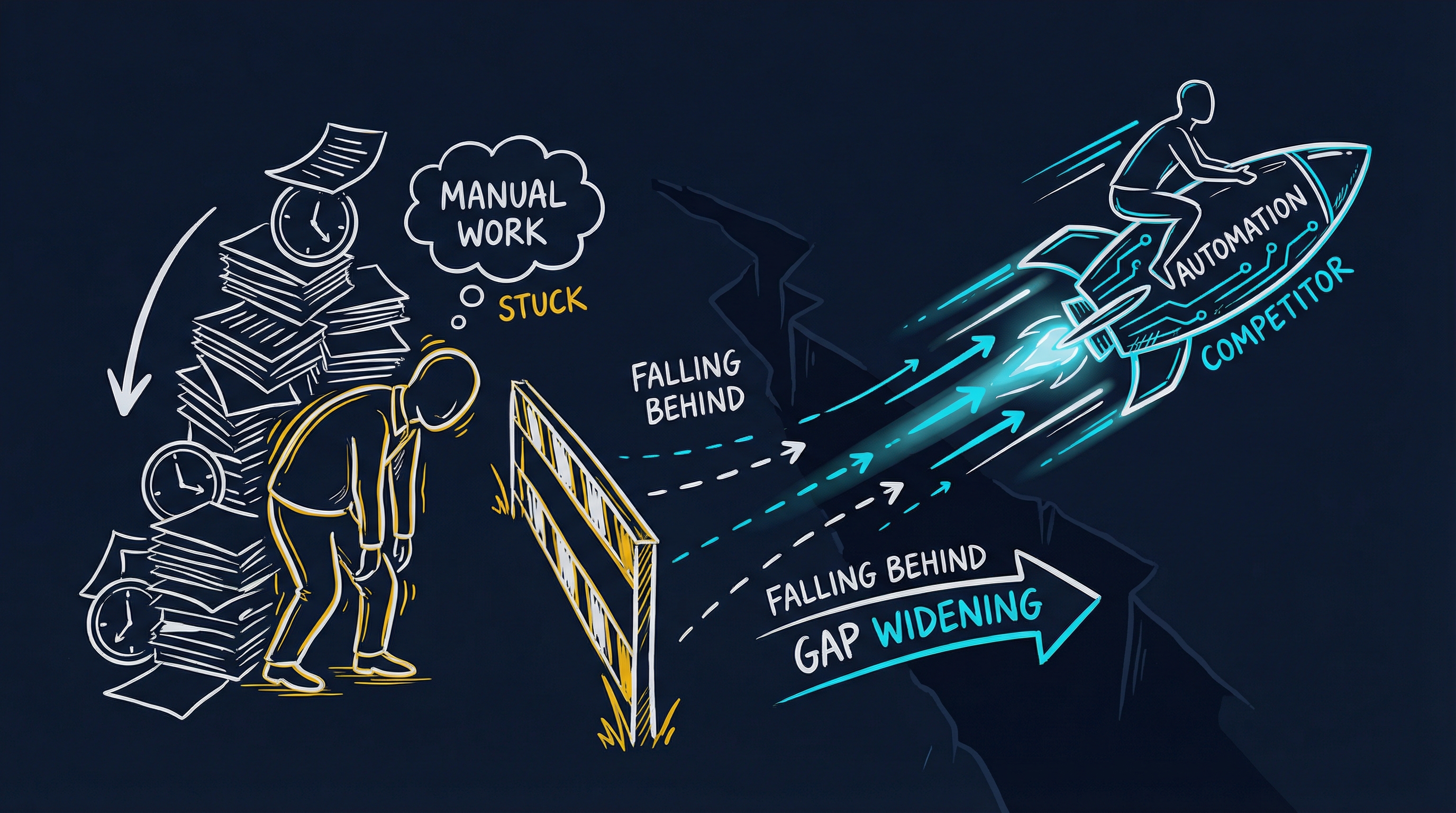
Contractors still doing manual updates will continue fielding constant “checking in” calls, working longer hours, and struggling to scale beyond 5-8 active projects.
Contractors implementing communication automation will handle 2x the project volume with better customer satisfaction scores, charge premium prices, and dominate referral business.
The gap between these two groups will become impossible to close.
Why? Because once a customer experiences automated project updates, it’s nearly impossible to get them to work with a contractor who doesn’t provide it. They’ve seen what professional operations look like.
You’re not just automating communication—you’re raising the competitive standard in your market.
From Reactive to Proactive (The Psychology Shift)
Manual communication keeps you reactive. You respond when customers reach out.
Automated communication makes you proactive. Customers receive updates before they think to ask.
This psychological shift is worth more than the time savings:
Reactive Communication (Manual):
- Customer calls → You respond → They feel reassured temporarily → Tomorrow they wonder again → Cycle repeats
Proactive Communication (Automated):
- Update arrives before customer wonders → They feel confident → Trust builds → They assume everything is handled → They refer friends
Trust compounds. With every automatic update, customers become more confident in your professionalism.
Finding The Right Communication Solution For Your Business
Every construction business has unique communication needs. What works for a roofing company might not fit a plumbing operation. Project timelines differ. Customer expectations vary. Communication frequency needs adjustment.
That’s why the first step is understanding exactly what your customers need to feel confident, and how automated systems can deliver that better than manual calls.
If you’re curious about how communication automation could work for your business, I offer a 60-minute Construction Automation Strategy Session ($150, credited toward implementation if you proceed). We’ll:
- Map your current communication patterns and calculate what interruptions are really costing you
- Identify specific automation opportunities that fit your project types and customer expectations
- Design a custom communication system that scales with your growth
- Calculate exact ROI projections showing break-even timeline and long-term savings
- Create a complete implementation roadmap with timeline and investment requirements
This is a premium consultation where you get actionable strategies and a specific plan, not generic advice.
CLICK HERE TO SCHEDULE YOUR STRATEGY SESSION →
Stop Trading Time For Updates
Your competitors are making this choice right now: Continue spending 12-18 hours weekly fielding “just checking in” calls, or invest in systems that communicate proactively.
The contractors who automate communication early establish customer service standards that competitors can’t match manually.
The ones who wait find themselves competing on price because they can’t differentiate on service quality.
Which contractor will you be 6 months from now?
P.S. - One-time investment, lifetime value: You own your automation system, not rent it forever. Unlike BuilderTREND ($6,000-$12,000 annually forever) or CoConstruct ($2,400-$3,600 annually forever), our automation breaks even in 14-18 months, then you keep the savings and competitive advantages permanently. The early contractors to automate their markets become the premium providers everyone else tries to catch.
Frequently Asked Questions
Q: How much time can automated project updates actually save?
A: Automated project communication typically saves 12-18 hours per week by eliminating “just checking in” calls from customers. For contractors managing 8-12 active projects simultaneously, this translates to 85-90% reduction in communication interruptions. Most contractors see immediate time savings within the first week of implementation, with compounding benefits as customer trust builds and update calls become virtually non-existent.
Q: What does construction communication automation cost?
A: Communication automation is included in the Growth Package, which ranges from $15,000-$30,000 depending on business size and integration complexity. Companies with 5-15 employees typically invest $15,000-$30,000 for complete implementation. The system includes automated milestone updates, photo sharing, scheduling notifications, and customer portal access. With 25% annual maintenance ($313-$625/month), most contractors achieve break-even in 3-4 months through time savings and premium pricing, with 300-500% ROI in the first year.
Q: Do customers actually prefer automated updates over personal calls?
A: Yes, overwhelmingly. Customer satisfaction surveys consistently show that systematic, proactive updates score higher than reactive phone calls. Customers value the ability to check project status on their schedule rather than calling and hoping for answers. Automated updates demonstrate organized, professional operations. Most contractors see customer satisfaction scores increase by 25-35% after implementing automated communication systems, with corresponding increases in referrals and repeat business.
Q: How quickly can automated project communication be implemented?
A: Growth Package implementation typically takes 45 days from contract signing to full deployment. This includes workflow mapping (week 1), system configuration (weeks 2-4), testing and optimization (week 5), team training (week 6), and go-live with 90-day optimization period. Most contractors begin seeing time savings within 2-3 weeks as initial automations activate, with full benefits realized by day 60-90.
Q: What if my projects are all different and require custom communication?
A: Automated systems excel at handling project variations. The Growth Package includes customizable communication templates for different project types, customer preferences, and milestone events. Systems can adapt messaging based on project category, customer communication preferences, weather delays, or material availability. The automation handles routine updates automatically while flagging unique situations that need personal attention. Rather than limiting flexibility, automation ensures consistent baseline communication while freeing you to focus on truly custom interactions.
AIL-3 | AI Transparency: This article was drafted with AI assistance and reviewed, edited, and approved by the author. All recommendations are based on 20 years of experience in the roofing and construction industry.